

There's a version of this article that opens with a definition of conversion rate optimization, walks you through a tidy three-step framework, and ends with a checklist you'll never use.
Instead of repeating basic CRO advice, this article explores how AI is fundamentally changing the way websites convert visitors.
What's happening with AI in digital marketing is far more nuanced—and more impactful—than many businesses realize.
AI has moved into the center of how people discover products, how they decide to stay on a page, and whether they convert at all.
The mechanics underneath websites, how content gets served, how intent gets detected, how moments of decision get shaped, have changed in ways that most teams haven't caught up to yet.
This piece is about what's actually different in website conversion optimization and what you should do about it.
In this article:
- AI-Powered Personalization Has Become the New Standard
- Behavioral Intelligence Is Replacing Surface-Level Analytics
- Where Conversational AI Creates the Biggest Conversion Gains
- AI-Powered Automation and Continuous Optimization
- Building the Data Infrastructure Behind AI Optimization
- The Future of Website Conversion Optimization
AI-Powered Personalization Has Become the New Standard
Why Generic Website Experiences No Longer Convert
Five years ago, personalizing a website experience meant showing someone their first name in an email or surfacing a product they'd already looked at. That was novel. Now, it's the floor.
And McKinsey's research links best-in-class personalization to outsized revenue impact compared to peers who aren't doing it well. The delta between "we personalize" and "we personalize well" is where the real money lives.
How AI Enables Personalization at Scale
What AI actually makes possible here is scale.
Real-time adaptation, like adjusting copy, layout, recommendations, and offers based on behavioral signals as someone moves through a session, used to require engineering lift that most teams couldn't justify.
Now, you can handle much of this without custom builds. You're not writing hundreds of page variants; you're defining the logic and letting the model figure out which experience fits which visitor.
Real-World Examples of AI-Driven Personalization
The practical examples aren't exotic:
- Retailers using AI-driven product recommendations see measurable lifts in add-to-cart rates.
- Subscription products that tailor onboarding flows based on the user's stated goals cut early churn.
- B2B sites showing dynamic case studies matched to the visitor's industry close demos faster.
Brands selling custom t-shirts and other configurable products have seen this play out clearly. When recommendation logic accounts for order history, design preferences, and quantity patterns rather than just category, it reduces the back-and-forth that typically stalls bulk and repeat orders.
None of this requires a massive team; this is what AI in digital marketing actually looks like when it's working.
It just requires the right data and a willingness to move beyond segment-based thinking toward individual-level adaptation.
The Business Impact of Individual-Level Adaptation
If your website is still serving the same experience to everyone, you're losing on every downstream metric that personalization affects.
Samuel Charmetant, founder of ArtMajeur, runs an online marketplace connecting independent artists with buyers across 100+ countries.
Behavioral Intelligence Is Replacing Surface-Level Analytics
Page views and bounce rate, as primary signals, create a dangerously incomplete picture of what's happening on your site.
The Behavioral Signals That Predict Conversion
The signals that actually predict conversion are behavioral: scroll depth, click sequences, hover patterns, time-on-section versus time-on-page, and cohort behavior across return visits.
These are the patterns that tell you whether someone is reading or just parking.
Denys Hukov, Chief Growth Officer at Yalantis, works with enterprise clients across manufacturing, IoT, and software development.
Using Predictive Analytics to Anticipate Customer Intent
Google Analytics 4 offers predictive metrics, like purchase probability, churn probability, and likely audience segments that surface intent signals humans can't parse from raw data alone.
This is where the shift matters most. You're no longer describing what happened. You're forecasting what's likely to happen next, and you can act on that forecast before someone leaves.
Why Unified Customer Data Matters
Pair any of these with a customer data platform that unifies identity across sessions and devices, and your data stops being interesting and starts being useful. Without that layer of unification, you're acting on fragments.
Where Conversational AI Creates the Biggest Conversion Gains
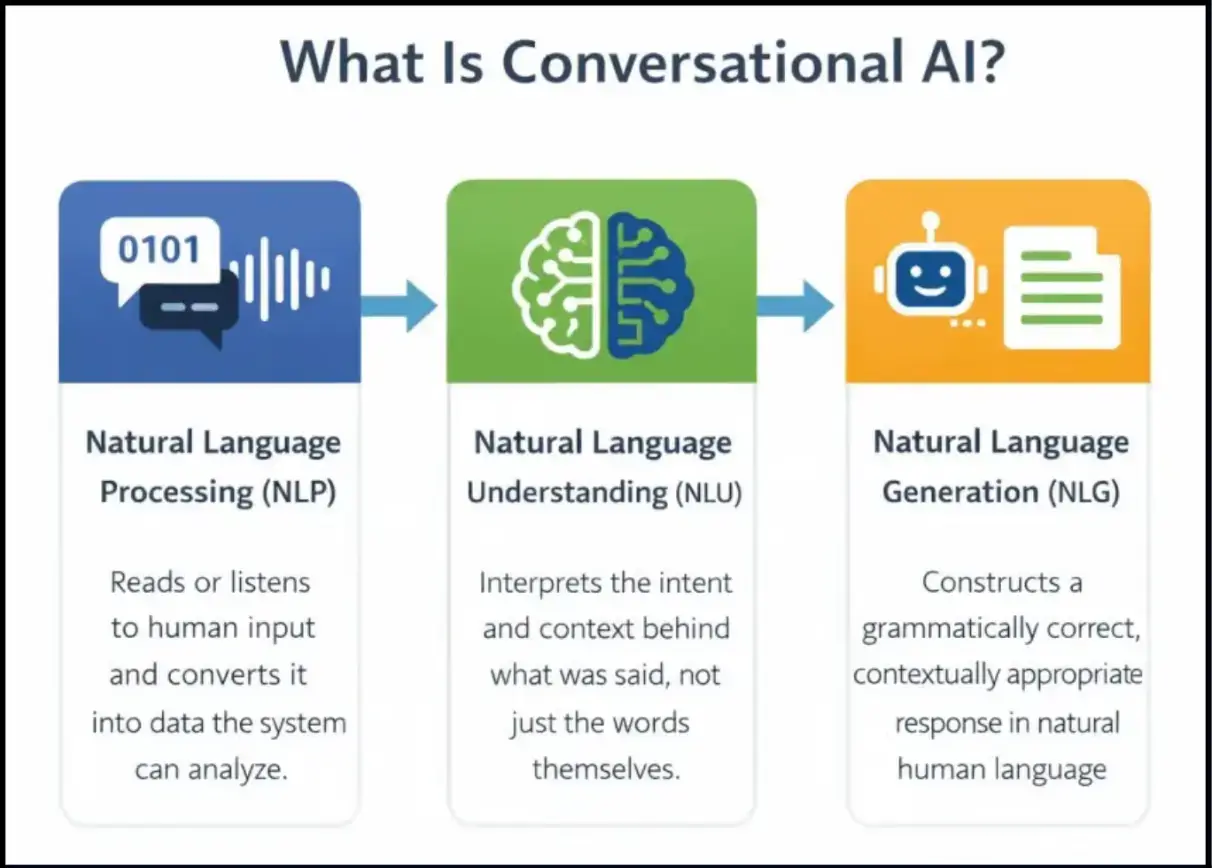
The Evolution of AI Chatbots
AI-powered chatbots have had a reputation problem.
For years, the experience was: vague prompt → "I'm not sure I understand, can you rephrase that?" → user leaves, more frustrated than before.
That era isn't completely over, but the tools have improved significantly.
Source: nextiva
High-Impact Use Cases for Conversational AI
The use cases where conversational AI earns its keep are specific:
- High-exit pages where a question-and-answer moment can recover a visitor
- Post-purchase flows where timing and context are everything
- Qualification steps that happen at odd hours when a human isn't available.
What actually works is narrowing the scope deliberately.
Why Narrowly Focused Bots Perform Better
A bot that does one thing well (answers the five most common pre-purchase questions, qualifies inbound demo requests, flags upsell opportunities based on behavior) outperforms a bot trying to replicate the full range of human support.
Preparing for Voice and AI-Assisted Commerce
The conversational direction is also pointing somewhere more interesting: voice and chat as primary commerce paths.
Schema markup and structured data become more valuable as AI assistants get better at surfacing products and services from clean data feeds.
If you haven't touched your structured data in two years, this is the time.
AI-Powered Automation and Continuous Optimization
How Marketing Automation Has Evolved
Marketing automation used to mean scheduled emails and simple lead routing rules, like workflows that fired based on form submissions.
That's still operating, and it still works, but it's no longer what AI in digital marketing means at the top of the category.
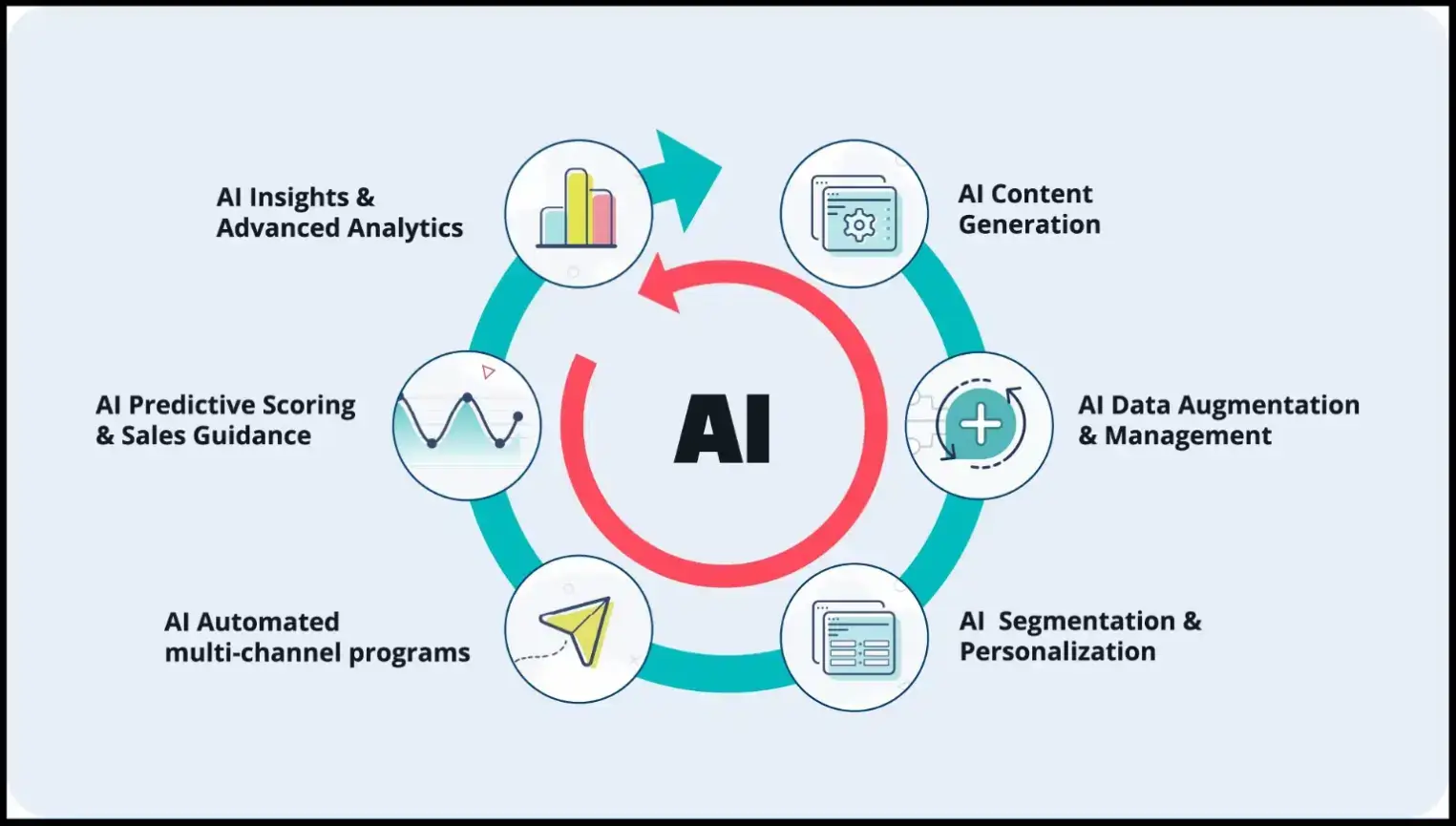
The current state: AI-guided systems that continuously run experiments across content variants, offers, page layouts, and messaging, learning from outcomes in real time and adjusting without human intervention between cycles.
Source: act on
From A/B Testing to Continuous Experimentation
Not the A/B tests you set up and check on Thursday. Self-improving loops that compound results over weeks and months.
Modern experimentation platforms have also gotten more rigorous about statistical validity.
The old problem with A/B testing was that teams would peek at results early, declare winners on small samples, and ship changes that didn't hold.
Approaches like sequential testing and Bayesian engines guard against this. The practical upshot: faster, more confident decisions with fewer false positives.
Ryan Beattie, Director of Business Development at UK SARMs, runs growth for an e-commerce brand operating in one of the more compliance-constrained corners of retail.
The teams using this well have essentially built a website conversion optimization engine that runs alongside their normal operations.
What Humans Still Need to Control
The human work shifts to strategy: what hypotheses to test, which segments to prioritize, and what the offer architecture should look like. The machine handles the testing cadence and the optimization.
The 2026 AEO & GEO Report published by Draft.dev confirms which content strategies are improving LLM visibility right now, including why human-assisted content generates 5.4x more traffic than AI-only workflows.
Building the Data Infrastructure Behind AI Optimization
Why Data Quality Determines AI Performance
Every AI-powered system driving website conversion optimization is only as good as the data it's learning from.
Which means if your tracking is messy, your personalization is learning the wrong lessons. If your identity resolution is inconsistent across devices, your predictive models are working with incomplete information.
Third-party cookies are fading. The direction of travel is clear, even if the timeline keeps shifting. Google's Privacy Sandbox outlines where things are heading.
Preparing for a First-Party Data Future
The practical response is to invest in first-party data now, before the transition forces your hand under pressure.
That means:
- Consent-forward tracking built on explicit opt-ins
- Server-side tagging to reduce reliance on client-side scripts
- Unified identity layer that works with what you actually own
Managing Website Performance and Core Web Vitals
Performance is the other thing worth watching.
AI tools and scripts add page weight. If your Core Web Vitals are suffering because you've layered in too many tools loaded synchronously, the conversion gains from personalization won't offset the losses from slower load.
Load scripts asynchronously. Maintain a tight script budget. Check performance regularly, not just at launch.
Baymard Institute's checkout research is worth bookmarking if checkout friction is your biggest conversion sink.
The Future of Website Conversion Optimization
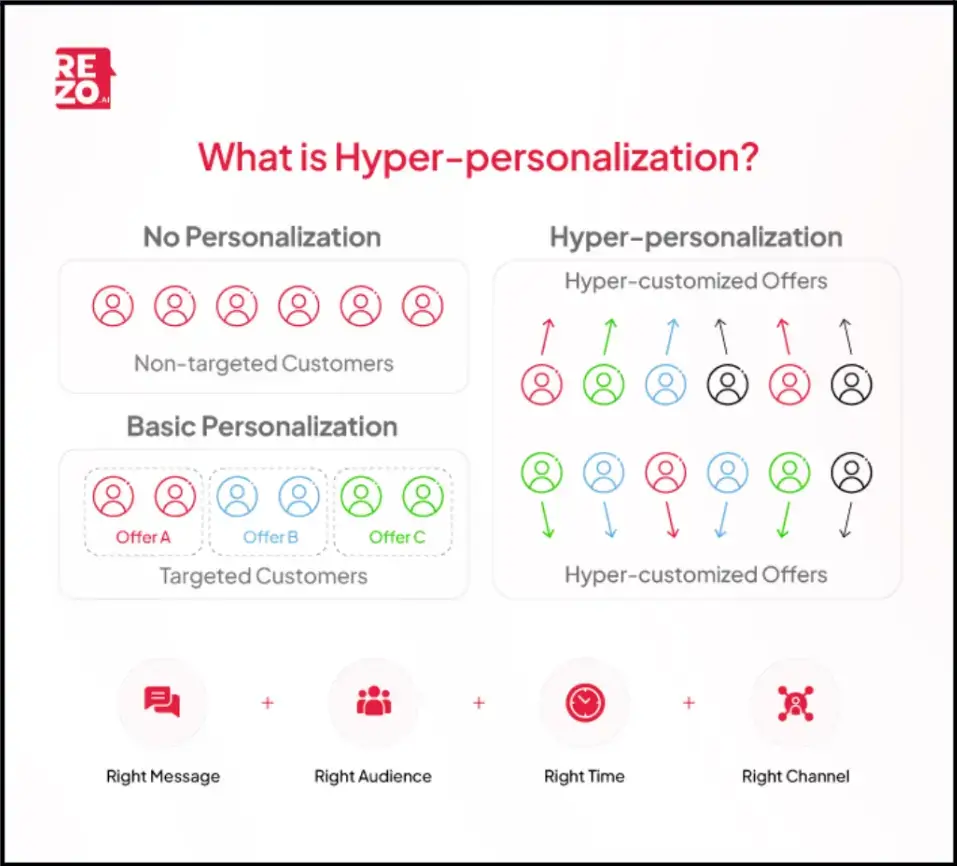
The Growth of Hyper-Personalization
Hyper-personalization is where website conversion optimization is heading fastest. The gap between a site that adapts to you and a site that guides you will become a competitive moat.
Source: Rezo.ai
The Emerging Role of Voice Commerce
Voice commerce is real but still early.
The infrastructure, clean structured data, fast load times, conversational content architecture, is worth building now, even if you're not expecting voice to move your primary conversion numbers this year.
Why Relevance Will Outperform Persuasion
The bigger shift is probably this: as AI in digital marketing matures, conversion optimization is becoming less about persuasion tactics and more about relevance at the right moment.
The sites that convert well in three years will be the ones that got genuinely good at understanding intent and responding to it with something actually useful. Not the ones with the most aggressive pop-ups.
The Path Forward for AI-Driven Conversion
The through-line across everything in this article is the same: intent, signals, and timing.
Personalization works when it responds to individual behavior rather than assumed segments. Behavioral analytics works when it moves past surface metrics toward what actually predicts action. Automation works when it runs continuous loops rather than one-off tests.
And all of it works only when the data underneath it is clean, consistent, and unified.
For small businesses and independent marketers, the order of operations matters:
- Fix the data foundation first.
- Pick tools that match specific jobs, not tools that promise to do everything.
- Run experiments continuously, not seasonally.
- And treat every improvement as an input into the next one.
The compounding is real. A site that gets meaningfully better at understanding intent every month looks very different at the end of a year than one that ran a CRO audit and called it done.
For teams looking to move quickly on the on-site execution side, no-code tools like POWR offer a practical way to test conversion moments while the broader infrastructure catches up. It's one option among several. What matters is that you start, measure, and iterate.
Frequently Asked Questions
Does AI-Driven Personalization Require a Large Team or Budget?
Not necessarily. The more important investment is in data hygiene. Getting your tracking and identity resolution right costs more time than money, and it's what makes every tool work better.
How Do I Evaluate AI Conversion Optimization Tools?
Work backwards from the specific moments you want to improve. First-visit engagement, cart recovery, demo requests, and renewals have different tooling needs. Tools that work across many use cases are usually mediocre at all of them. Pick for the job.
What's the Biggest AI Conversion Optimization Mistake?
Skipping data foundation work and going straight to tools. Personalization models learning from inconsistent or fragmented data build bad intuitions quickly. Fix the data first.
Is Voice Commerce Worth Investing In Today?
For most businesses, building for voice as a primary channel is premature. Investing in structured data and clean product feeds now is not. That work benefits both AI assistants surfacing your products and conventional search.
How Can I Balance Privacy and Behavioral Data Collection?
First-party data, explicit consent flows, and server-side tagging. The constraint is real but workable. Users who opt in and engage are more valuable training data than broad anonymous signals anyway.

Author Bio
Jesse is a professional writer whose aim is to make complex concepts easy to understand. He strives to provide quality content that assists people in everyday life.