

The success of an email marketing campaign has traditionally been measured by metrics such as open rate and click-through rate.
However, as any seasoned email marketing professional will tell you, these metrics are unreliable and do not reflect the quality of the leads or the campaign itself.
In this article:
- How Micro-Conversions Reveal Lead Quality
- How to Track Micro-Conversions Effectively
- How to Optimize Email Campaigns for Micro-Conversions
Email clients typically run bot scanners and image preloading processes that can artificially inflate open rates. Click rates are not always indicative of an engaged audience or one that is primed for conversion.
In short, the parameters that define traditional email marketing success have failed to deliver. To ensure lead quality and run a successful email marketing campaign, you need to look beyond the basics.
What Are Micro-Conversions in Email Marketing?
Micro-conversions are small, intent-driven actions that demonstrate high lead quality and signal purchase interest.
These could be events that lead the subscriber to your marketing collateral, such as downloading an ebook, watching a video, or visiting the pricing page.
Micro-conversions are not actions that result in an immediate sale. They take the visitor one step closer to becoming a more nurtured lead. In simpler words, micro-conversions sit snugly between initial engagement and the final conversion.
When assessing the performance of an email marketing campaign, micro-conversions provide a more effective measure of lead quality and campaign progress than traditional metrics like open rate and click rate.
Micro-conversions indicate buying interest and help improve your lead scoring accuracy. You can say micro-conversions are the little steps a potential lead takes towards a macro-conversion. As such, it is a more reliable metric to forecast future revenue.
In contrast, macro-conversions are typically the end goal of an email marketing campaign. This could be a product purchase, a demo booking, or a subscription.
If you are engaging with an existing customer, a macro-conversion could also be when this customer uses a referral link with tools like ReferralCandy to share your offer with their network.
How Micro-Conversions Reveal Lead Quality
While a micro-conversion is not the final goal, such as a purchase or demo booking, it is a powerful signal of lead quality because it reveals intent, interest depth, and buying stage.
Micro-conversions deliver a signal that the lead is progressing in the right direction. Think of them as milestones on the road towards the final conversion.
There are typically three kinds of signals that a micro-conversion delivers.
1. Content Engagement Signals
Traditionally, content engagement in email marketing is measured with click rates. However, this metric is misleading and does not indicate high lead quality. There are instances when a visitor clicks on links accidentally or out of curiosity.
While this still indicates that the subscriber is engaging with your content, they are not the kind of leads that progress towards sales. You need subscribers who engage with your content the way you intend.
You need subscribers who don’t just click through links in your email, but also download gated content from the landing page.
If a click takes them to a video, you need to track how many of those clicks result in at least 75% of the video's watch time. Similarly, if the click takes the subscriber to a blog post, how many of these clicks translate into spending at least 5 minutes on the website?
These are not hard-and-fast rules, but general guidelines for what makes an event truly impactful from a macro-conversion perspective.
The number of subscribers who download gated content, watch at least 75% of a video, or spend 5 minutes on the website could also be micro-conversions that indicate high-quality leads.
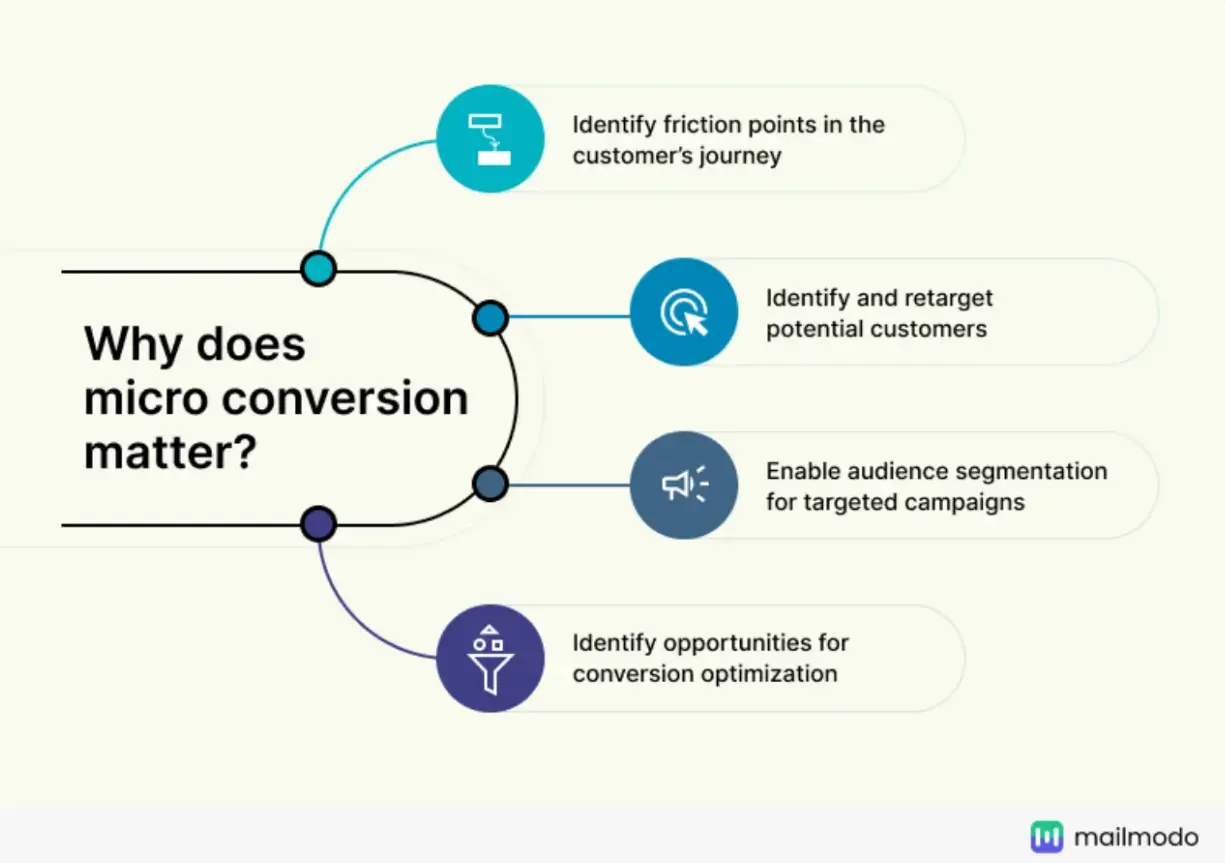
Source: Mailmodo
2. Product Interest Signals
Email automation campaigns typically run on a rotational model, where the campaign sequence rotates through TOFU (Top of the Funnel), MOFU (Middle of the Funnel), and BOFU (Bottom of the Funnel).
BOFU emails give marketers the opportunity to track micro-conversions via product interest signals. This includes clicks to purchase-intent-driven pages, such as an ROI calculator, your Pricing page, or Product Comparison page.
Clicks to these pages, along with sufficient engagement, indicate that the subscriber is actively evaluating your product.
3. Sales-Ready Signals
When you get a new subscriber to your email marketing newsletter, they are generally considered a warm lead - a Marketing Qualified Lead (MQL), in other words. These are leads who fit your target audience profile, but may not necessarily be in the market for your product or service.
It is not until these subscribers are nurtured and demonstrate clear sales-readiness that they achieve higher lead quality scores. This readiness is measured with signals such as booking a webinar, starting a free trial, or requesting product information.
Each of these signals is a micro-conversion that improves the lead score and is a step towards a macro-conversion.
How to Track Micro-Conversions Effectively
Although email marketing campaigns do much of the legwork in nurturing subscribers and moving them toward macro-conversion, the native analytics tool cannot capture much of this data.
This is because most micro-conversions occur after a subscriber clicks a link and lands on your landing page.
Your website analytics systems must be comprehensive and track information on specific UTM parameters, time spent on each page, a heatmap of where visitors spent their maximum time, videos watched, etc.
Here are some events and triggers your email marketing team must implement to track micro-conversions more effectively.
Behavioural tracking: Track user journey beyond just the clicks. Understand what links get the highest clicks, what visitors look for and engage with in the landing page, and how much time they spend on these pages.
Event-based tracking: Look for scroll depth, time spent on the pages, button clicks, etc.
Trigger-based workflows: Your email automation system should enable intent-driven segmentation to improve lead quality and macro-conversions. Integrate your email marketing and analytics tools with your CRM, or use CRM with email marketing software, to direct your subscribers to the right subsegments based on certain triggers.
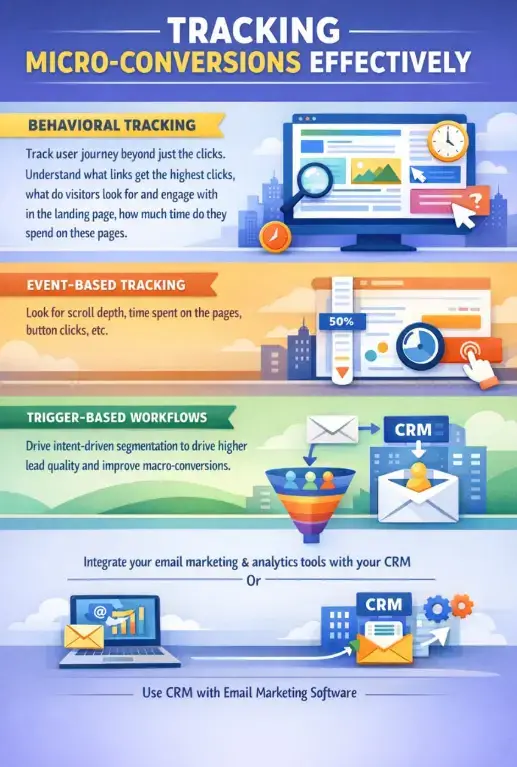
For instance, if a subscriber clicks on a product pricing page, you could automate your segmentation to move the subscriber from your marketing mail list to a more sales-focused mailing list.
How to Optimize Email Campaigns for Micro-Conversions
The objective of an email marketing campaign is to nurture the leads - that is, to move the subscribers along the lead scoring cycle from warm to hot leads before they eventually convert.
Micro-conversions are milestones in this journey that track progress towards the macro-conversion. Optimizing your email sequences for micro-conversions is thus a critical component of a successful campaign.
Lead Scoring Based on Intent Signals
Before you begin optimizing your email marketing campaign for micro-conversions, you need to set up tracking systems to benchmark your lead performance.
This way, a high-intent activity (like viewing the Pricing page) is assigned a higher weight than a low-intent activity (like downloading gated content), and these values rank leads and assess their quality.
Lead scoring helps measure lead quality and enables automated segmentation, allowing high-scoring leads to be moved to a more sales-focused email sequence while other marketing-qualified leads continue to be nurtured with the default sequence.
By using a robust lead generation tool, businesses can streamline scoring models, automate segmentation, and ensure the right prospects receive the right message at the right time.
Once this benchmarking setup is complete, we may proceed with the optimization process. This is a three-step process.
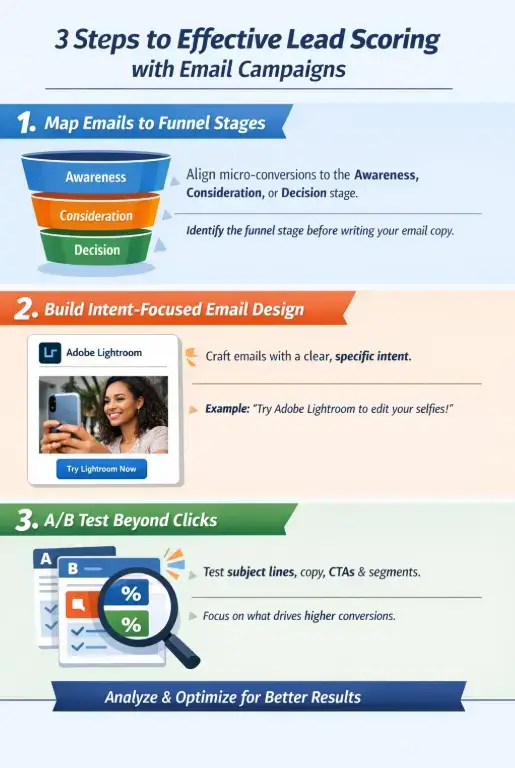
Step 1: Align Emails With Funnel Stages
For effective lead scoring, micro-conversions need to be tightly aligned to specific funnel stages. The funnel stages include awareness, consideration, and decision.
Before drafting your email copy, identify the funnel stage and ensure your micro-conversions are aligned with it.
Step 2: Design Emails Around Intent
Each email in an email campaign should drive the subscriber toward a specific intent.
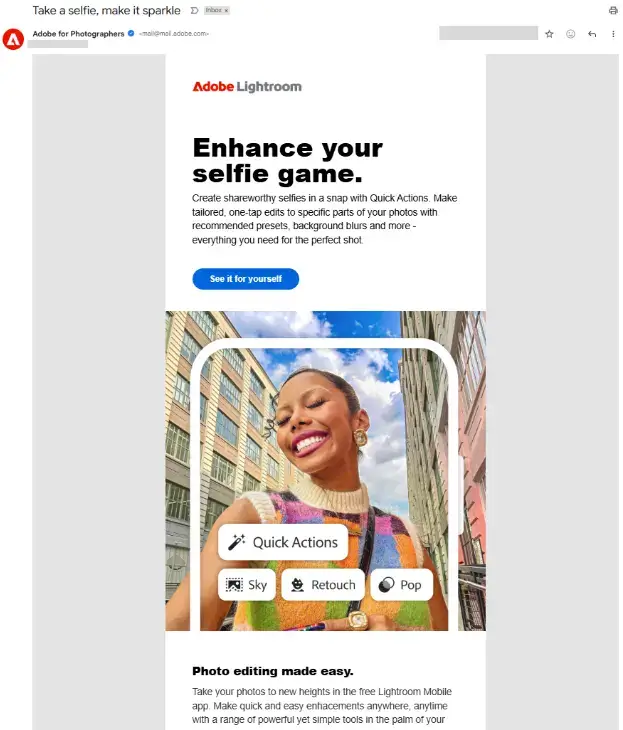
Take this example from Adobe Photoshop: the subject line, the Call to Action, the embedded image, and the email copy are all geared towards one specific intent: getting people to try Adobe Lightroom to edit their selfies.
Step 3: A/B Test for Intent, Not Just Clicks
There are a lot of moving parts that can help or hinder an email marketing campaign - the subject line, the email copy, the value proposition, the segment of audience you are reaching out to, and the Call to Action can all play a part in driving the success (or failure) of your campaign.
An effective A/B tested campaign provides marketers with the necessary insights to know what works and what doesn’t - and thus focus on elements that help drive higher micro-conversions.
Conclusion: Replace Vanity Metrics With Intent Signals
Email opens and clicks are signals, not outcomes. Micro-conversions help bridge the gap between engagement and revenue and move marketers away from vanity metrics toward more intent-based tracking.
However, context is important. Tracking too many low-value actions or failing to identify amplifiers, such as repeat visits, can lead to the wrong insights.
Micro-conversions must align with business goals. Otherwise, this could be another futile attempt at driving real impact through analytics.
FAQ: Improving Email Marketing Lead Quality With Micro-Conversions
1. What are Micro-Conversions in Email Marketing?
Micro-conversions are small but meaningful actions that subscribers take when engaging with an email newsletter. This could be clicking on a link to download an ebook, or watching at least 75% of a shared video. These actions demonstrate intent and engagement and are considered important milestones towards a macro-conversion.
2. How are Micro-Conversions Different from Macro-Conversions?
Macro-conversions (or simply conversions) are actions that result in meeting primary business goals. This could be purchasing a subscription, signing up for a free trial, or requesting a demo.
In contrast, micro-conversions are actions that validate that the lead is being effectively nurtured and is on the path towards a macro-conversion.
3. Why Shouldn’t Marketers Focus Only on Clicks?
Email marketers typically focus on metrics such as open rates and click-through rates. These are vanity metrics that can be both misleading and not useful. Clicks indicate activity, but do not measure intent or lead quality.
A subscriber can click out of curiosity or accidentally. Unless the click results in meaningful activity, such as downloading an ebook or watching a video, it does not demonstrate high-intent engagement.
4. How Do You Optimize Email Campaigns for Micro-Conversions?
Optimizing emails for micro-conversions is a three-step process. First, map each email in the sequence to the relevant stage of the funnel. This helps you identify the exact micro-conversion metric to track. Next, build an email copy that is highly intent-focused and drives subscribers toward the specific goal. Finally, run A/B tests across the entire sequence to optimize the various moving parts that can affect the campaign's end result.

Author Bio
Anand Srinivasan is the founder of LeadJoint, a cold email outreach agency that has worked with hundreds of small and medium-sized businesses on their lead generation.