

E-commerce businesses generate massive amounts of data every day—from browsing behavior and purchase history to abandoned carts and repeat visits. When used correctly, this data can reveal patterns that predict what customers are likely to do next.
In this guide, we’ll explore how e-commerce data can be used to predict customer behavior, personalize marketing, and boost online sales, with practical examples that small and mid-sized businesses can actually implement.
In this article:
- Key Types of E-Commerce Data You Should Be Tracking
- Predicting Customer Lifetime Value and Purchase Intent
- Turning Data Insights Into Higher Conversion Rates
- The Role of AI and Machine Learning in Predictive E-commerce
E-commerce provides tools to predict customer trends from online shopping behaviour and the opportunity to make predictions based on the information available to online stores.
This article outlines how e-commerce datasets provide insight into consumer trends; the types of e-commerce data that are valuable to a business; and the best approaches for driving profitable revenue through predictive analysis of your customers' shopping experiences and purchases.
From Descriptive to Predictive Analytics
Source: Predictive Analytics World
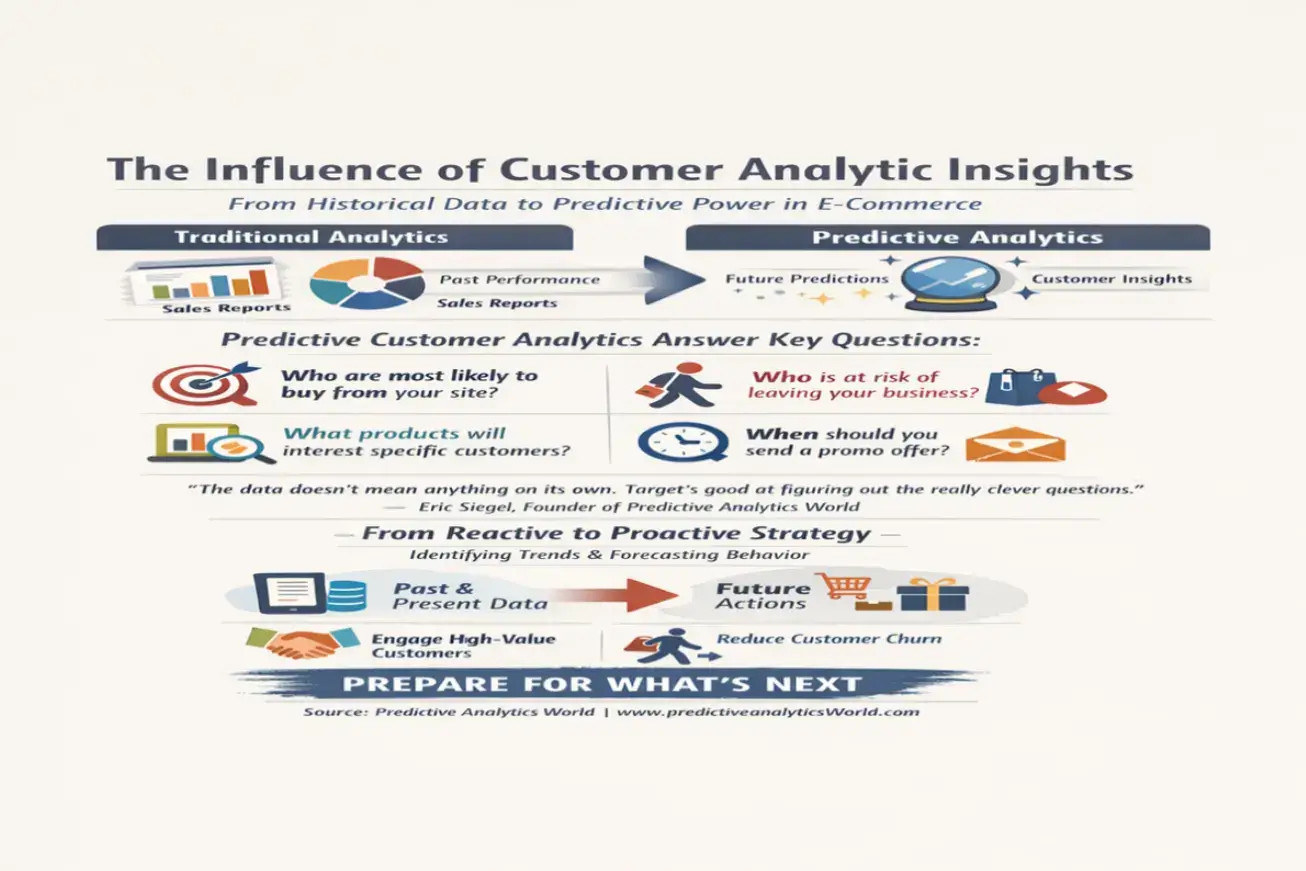
E-commerce analytic tools have focused on what is already occurring (last month’s revenue, highest selling product, and average order value), while predictive customer analytic tools allow online retailers to forecast events that will take place in the future (predictions are based on customers' historical behaviour):
- Who are the most likely customers to transact with (buy from) your site?
- Who is likely to leave your business?
- What products are likely to be of interest to a particular customer?
- When will you send a promotional offer to the defined customer group?
Predictive models identify customer trends and behaviours using historical and current data, helping determine potential outcomes of customer interactions and enabling retailers to prepare for future interactions.
Retailers have shifted from being reactive in making customer-related decisions to proactively developing strategic plans that offer the most appropriate opportunities (consumer products) to customers when they are most likely to act.
Key Types of E-Commerce Data You Should Be Tracking
There are numerous aspects of ecommerce to consider when building accurate predictive models.
Source: Predictive Analytics World
1. Behavioral Data (Clicks, Views, Cart Activity)
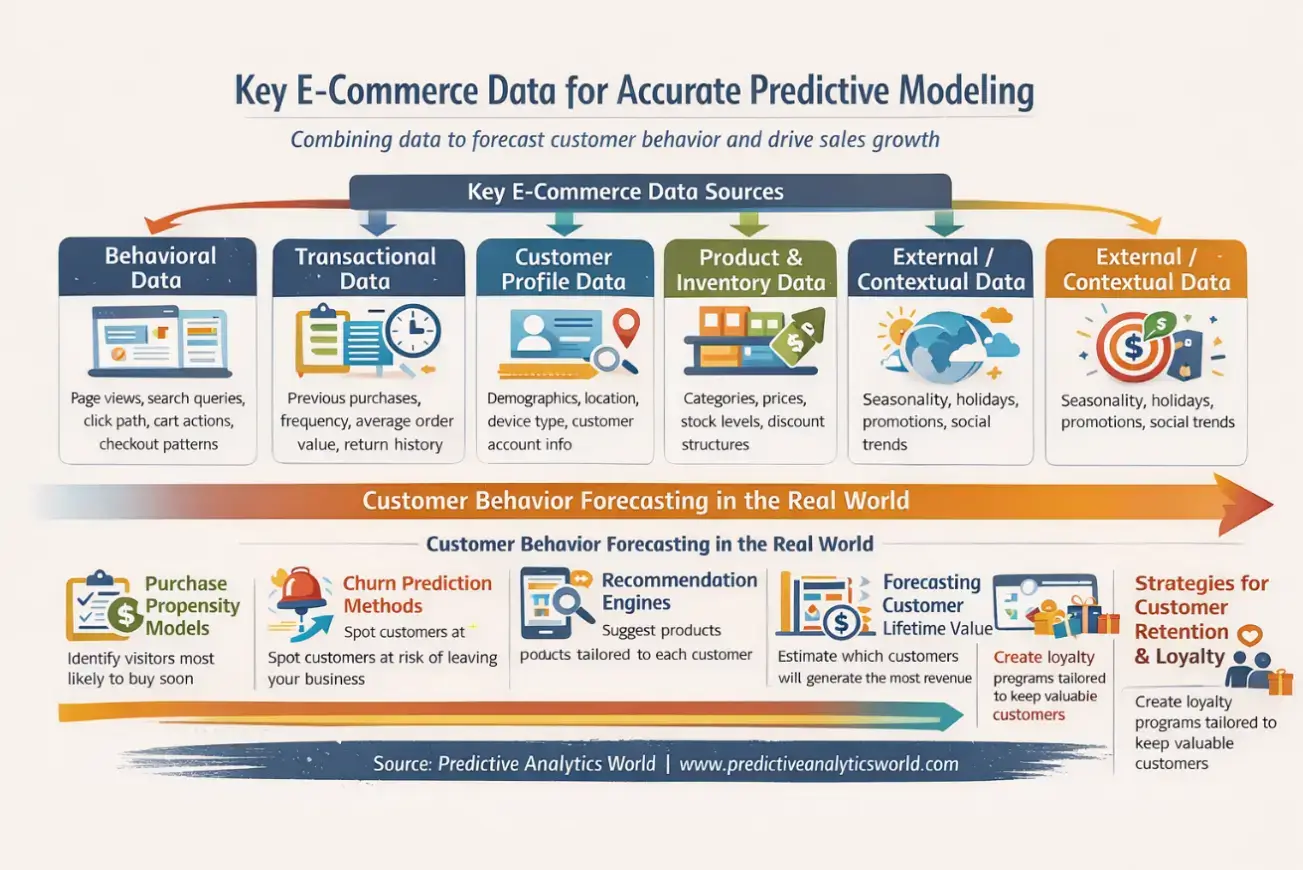
Behavioral data captures how users interact with your website and mobile app, including page views, search queries, click paths, time spent on pages, items added to the cart, and checkout behaviour.
Users' browsing behaviours often indicate whether they’re going to buy or hold off on a purchase; therefore, this data is critical for building predictive conversion models.
2. Transactional Data (Purchases, Frequency, Returns)
Transactional data consists of an individual's previous purchases, how often they purchased items, the average dollar amount of their purchases, when and how they purchased items, and how many items they returned.
Meaningful insights can be derived from transaction history, including lifetime value, repeat-purchase likelihood, and customer loyalty, ultimately enabling accurate predictive lifetime value models.
3. Customer Profile & Demographic Data
A customer profile dataset includes demographic fields (age, sex, income level, etc.), geographic location, the device type used to access your store, and any associated customer account details.
When combined with behavioral and transactional data, these data can create highly accurate customer segments and personalize the shopping experience.
4. Product, Pricing, and Inventory Data
Product categories, pricing history, available inventory and discount structures impact how and why customers buy items.
Predictive models can use product and inventory data to forecast customer purchase demand, make sound product recommendations, and optimize pricing strategies.
5. External & Contextual Data (Seasonality, Events, Trends)
Factors such as seasonality, holidays, promotional events, social trends, and local weather patterns can also influence buyer behavior.
If you incorporate these external signals into your predictive models, you will improve the accuracy of your demand forecasting and campaign planning.
Predicting Customer Lifetime Value and Purchase Intent
After businesses aggregate their data, they can use predictive modeling techniques to analyze and forecast customer behavior.
Purchase Propensity Modeling
By using historical data on product interest, browsing depth, and purchase patterns, companies can estimate which site visitors or customers will buy products in the next few days. These estimates enable businesses to direct targeted campaigns to customers most likely to purchase.
Churn Prediction & Retention Signals
Through churn prediction methods, businesses identify customers most likely to discontinue engagement with the company or stop purchasing products.
Warning signs of churn may include reduced website visit frequency, lower total order value, or abandoned shopping carts.
Identifying customers at risk of churn enables companies to develop retention strategies, such as sending re-engagement emails or personalizing discounts.
Recommendation Engines & Personalization
Recommendation engines use previous purchases and browsing history to predict which products customers are likely to buy next.
With personalized recommendations, a company's conversion rates and average orders will be higher than without them.
Forecasting Customer Lifetime Value (CLV)
Forecasting customer lifetime value helps businesses identify which customers are most likely to generate the highest revenue over time; therefore, businesses use this information to allocate their marketing budget, develop loyalty programs, and prioritize customer service efforts.
Turning Data Insights Into Higher Conversion Rates
Predictions alone don't generate revenue; they require action to create it. The greatest value of predictive insights lies in incorporating and using them into an organization’s daily operations.
Personalized Marketing Campaigns
Marketers can use predictive insights to customize their marketing communications to specific customers.
Businesses can use predictive insights to send customers personalized offers, resources, or replenishment reminders when their purchase intent is highest.
Dynamic Pricing and Promotions
By forecasting demand and pricing precisely as it unfolds through predictive insights, an organization can adjust or optimize competitive prices or discounts according to the current demand.
Website & Checkout Experience Optimization
The best way to predict a customer's purchase intent is to personalize the entire browsing and purchasing process. The homepage, search results, basket, and checkout processes can dynamically adapt to the customer based on their purchase intent.
Smart Inventory & Demand Planning
Predictive insights will enable organizations to identify the most likely products to sell and which ones can remain in inventory until sold out. The result is the prevention of stockouts, leading to better sales and lower costs associated with overstock.
Customer Retention and Loyalty Strategies
To improve customer retention and loyalty, businesses must first identify which customers are most valuable and which are at risk of leaving.
Businesses can then create tailored incentives and programs designed to keep customers engaged for longer periods. Engaging current customers is generally considered more cost-effective than acquiring new ones.
The Role of AI and Machine Learning in Predictive E-commerce
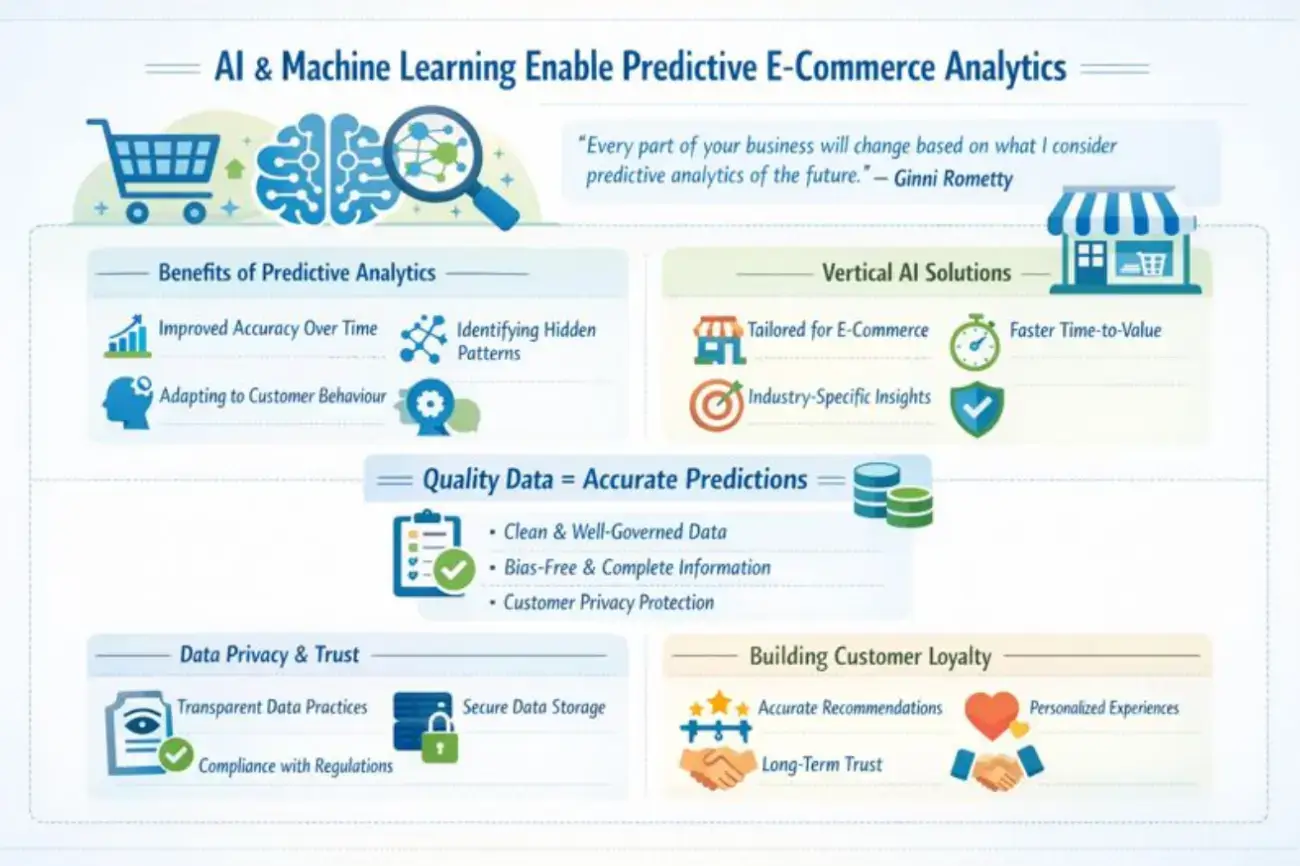
Predictive e-commerce analytics rely heavily upon artificial intelligence (AI) and machine learning (ML). Unlike static rules, ML models continue to improve accuracy over time as they are trained on additional data.
In addition, ML can process large amounts of data, identify hidden patterns, and adapt to changing customer behaviours.
Many e-commerce companies have invested in vertical AI solutions (i.e., those designed specifically for retail and e-commerce applications) rather than generic analytic tools because vertical AI solutions deliver faster time-to-value for their industry and outperform generic tools.
Vertical AI solutions natively understand the complexities and uniqueness of their respective industries' data structures, performance metrics, and other challenges.
Source: venngage
Why High-Quality Data Is Essential for Accurate Predictions
The success of predictive analytics relies heavily on high-quality (clean, accurate, and well-governed) data.
If the data is incomplete or biased, predictions from such datasets will be inaccurate, resulting in a damaged customer experience.
Likewise, businesses must protect their customers' privacy by having approved policies for how they collect, store, and protect customer data, and by complying with data protection regulations.
Customers want transparency about how their information will be used; therefore, adherence to these principles helps build long-term trust and loyalty between customers and the business.
Conclusion
Using e-Commerce data to predict customer behaviour has become increasingly important. As consumers continue to evolve, so too must the retailers that cater to them.
Predictive analytics combines behavioural, transactional, and contextual data to help retailers determine customer needs, when customers require service, and how best to deliver it.
The predictive value of predictive analytics can drive higher conversion rates, lifetime customer value, and sales growth for retailers that incorporate it into their marketing strategies, personalization techniques, pricing models, and operations.
By applying predictive insights within a data-driven model to generate actionable outcomes, e-Commerce retailers are better equipped than ever to respond to the growing demands of an increasingly demanding consumer base.
Frequently Asked Questions About Predictive E-commerce Analytics
1. What Types of E-commerce Data Are Most Valuable?
The article identifies five key data types:
- Behavioral Data: Page views, search queries, click paths, time on pages, cart activity
- Transactional Data: Purchase history, frequency, average order value, return patterns
- Customer Profile Data: Demographics (age, income), location, device type, account details
- Product and Inventory Data: Categories, pricing history, inventory levels, discount structures
- External/Contextual Data: Seasonality, holidays, promotions, social trends, weather patterns
Combining these datasets creates the most accurate predictive models for conversion, lifetime value, and personalization.
2. How Do Businesses Convert Predictions Into Sales Growth?
Predictions must be integrated into daily operations through:
- Personalized Marketing Campaigns: Targeted offers and replenishment reminders when purchase intent is highest
- Dynamic Pricing & Promotions: Adjust prices/discounts based on real-time demand forecasting
- Optimized User Experience: Personalize homepages, search results, and checkout processes based on predicted intent
- Smart Inventory Planning: Prevent stockouts and reduce overstock costs by predicting which products will sell
- Customer Retention Strategies: Identify at-risk customers and high-value segments for tailored loyalty programs
3. What Role Do AI and Machine Learning Play?
AI/ML are essential because they:
- Continuously improve accuracy as more data is fed into models
- Process massive datasets and identify hidden patterns humans cannot detect
- Adapt to evolving customer behaviors in real-time
- Vertical AI solutions (designed specifically for retail) outperform generic tools by understanding industry-specific data structures and metrics, delivering faster time-to-value.
4. What Are the Prerequisites for Success?
Two critical foundations are required:
- High-Quality Data: Predictions are only as good as the data. Incomplete, inaccurate, or biased data leads to flawed predictions and damages customer experience. Data must be clean, accurate, and well-governed.
- Privacy & Compliance: Businesses must have clear policies for data collection, storage, and protection that comply with regulations. Transparency about data usage builds long-term customer trust and loyalty, which is essential for sustained success.

Author Bio
Scarlett Wei found her passion in Technology and Fintech. She thrives on leveraging computational strategies and data analysis to drive innovation and improvement. As an experienced content creator, she specializes in helping businesses enhance their online presence by securing high-quality backlinks from authoritative SaaS and B2B platforms. Email Scarlett Wei to explore collaboration opportunities.