
They never drink coffee (or tea). They never take days off. They never miss deadlines. And they hit all marketing goals.
What are they—robots?
Close, but not quite. These are AI agents.
In this article:
- Top 7 Ways to Use AI Agents in Marketing
- Content Creation & Full Workflow Automation
- Customer Journey Orchestration & Personalization
- Search Engine Optimization (SEO)
- Ad Campaign Optimization
- Competitor & Trend Monitoring
- Event Management
- Team Collaboration & Workflow Cohesion
- Bonus: AI Agent Builders for Custom Marketing Tasks
If 2024 was the year businesses only “played” with AI in digital marketing, 2025 is the year artificial intelligence starts working for them just as another employee.
Agentic AI is probably the newest trend and the next biggest thing for marketers. It isn’t riding the marketing wave—it is the wave.
In fact, 62% of companies are already experimenting with AI agents, anticipating a 100%+ ROI from this advanced tech, and 11% focus specifically on marketing and sales. Also, more than half of brands expect that agentic AI will automate between 26% and 50% of their workload.
So, let’s understand what this trendy buzzword means and how you can benefit from AI agents in marketing.
What Is Agentic AI for Marketers?
An AI agent is a virtual helper that autonomously performs marketing tasks rather than simply responding to prompts. It can plan, execute, make mid-campaign changes, and analyze outcomes without human intervention.
For example:
Let’s take email marketing with AI agents. Instead of waiting for your prompt like, “Write an email to [Customer],” they would do the following self-sufficiently:
- Develop a perfect email marketing strategy for your brand.
- Plan and schedule all the future emails.
- Write irresistible subject lines and design stunning emails.
- A/B test email campaigns.
- And report back on the results—all while you keep tabs (literally) on it as a manager, having free time (at last!) to let your creativity loose or do other critical tasks.
Unlike chatbots or other conversational AI, they don’t simply operate in a prompt-and-response format. They are also capable of:
- Autonomous decision-making → They make wise decisions independently without the marketer’s nudge.
- Learning → They analyze historical data and learn from it, identify marketing blind spots (or oversights) and mistakes, and make workflow improvements on the fly.
- Adaptation → They adapt to the circumstances and real-time challenges and changes (and trends!).
- Orchestration → They orchestrate AI tools and keep them all in one curated e-hub.
Top 7 Ways to Use AI Agents in Marketing
Now, let’s see how you can use agentic AI for marketing.
1. Content Creation & Full Workflow Automation
Generative AI, or GenAI, in content creation is already sooo last season.
Today, AI agent platforms can manage your entire content marketing workflow, from ideation to cross-posting across channels.
Or even going the extra mile for you: ordering you a croissant or donut for lunch from your favorite coffee shop—no kidding!
For example:
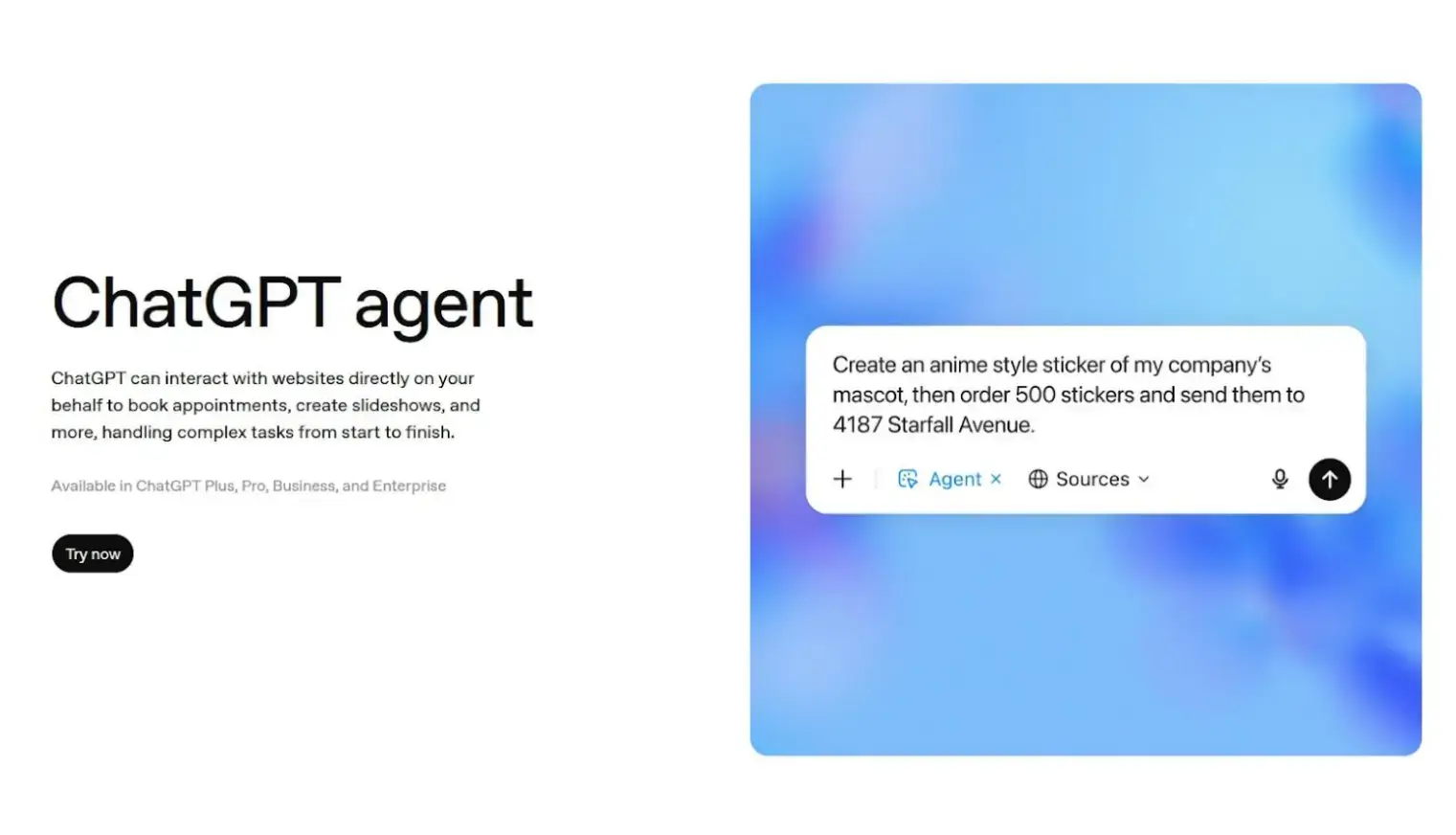
ChatGPT, one of the most popular GenAI tools for marketers, underwent an upgrade and released a new feature: ChatGPT Agent. It not only generates any content (text, image, or video) but also books appointments or even places corporate orders on your behalf.
In the travel sector, AI is already transforming content workflows by automating destination research, itinerary building, and storytelling, which highlights the growing role of AI in travel content for brands and agencies.
Alternatively, let’s explore the case of agentic AI for social media marketing (SMM). A traditional GenAI tool normally generates scroll-stopping social posts (with branding elements and everything...).
But now, you can “hire” an AI agent that also schedules your social media content, tracks engagement rates, or even drafts witty replies to users’ comments on your posts. Well, that’s quite a thing, isn’t it?
2. Customer Journey Orchestration & Personalization
Just like a tour guide (but without an umbrella), an AI agent can map the customer journey and guide them toward the right buying decision. It will spot even the tiniest breadcrumb customers leave behind on their paths to “Add to cart”:
- First interaction touchpoint
- Browsing/searching pattern
- Content consumption preference (format, channel, timing, etc.)
- Shopping behavior
- Engagement signal (scrolling through, double-clicking, commenting, sharing, etc.)
- Loyalty trigger
This is how you can use agentic AI for personalization to create the “Wow, it’s like they’re reading my mind” type of customer experience.
For example:
Let’s take a debt settlement company in the finance industry.
An AI agent could analyze the customer’s credit card data and overall financial situation in seconds and recommend the best debt relief program based on those insights.
It’s like a product finder or recommendation quiz, but way much smarter because customers don’t even have to fill it in.
3. Search Engine Optimization (SEO)
Sick and tired of XX-tab spreadsheets for SEO? Hand them over to an AI agent dedicated to search engine optimization, often lifting the heaviest weight for marketing success.
For example:
Let’s see how agentic AI can supercharge a link-building strategy in SEO.
First, it might analyze websites and check domain authority score for each to identify high-DA blogs for guest posting and linking back to your site.
It could also suggest (and generate!) better replacement content, or even write a perfect outreach email to the blog owner, with a warm greeting and a humble request to replace the article with the “freshly baked” one.
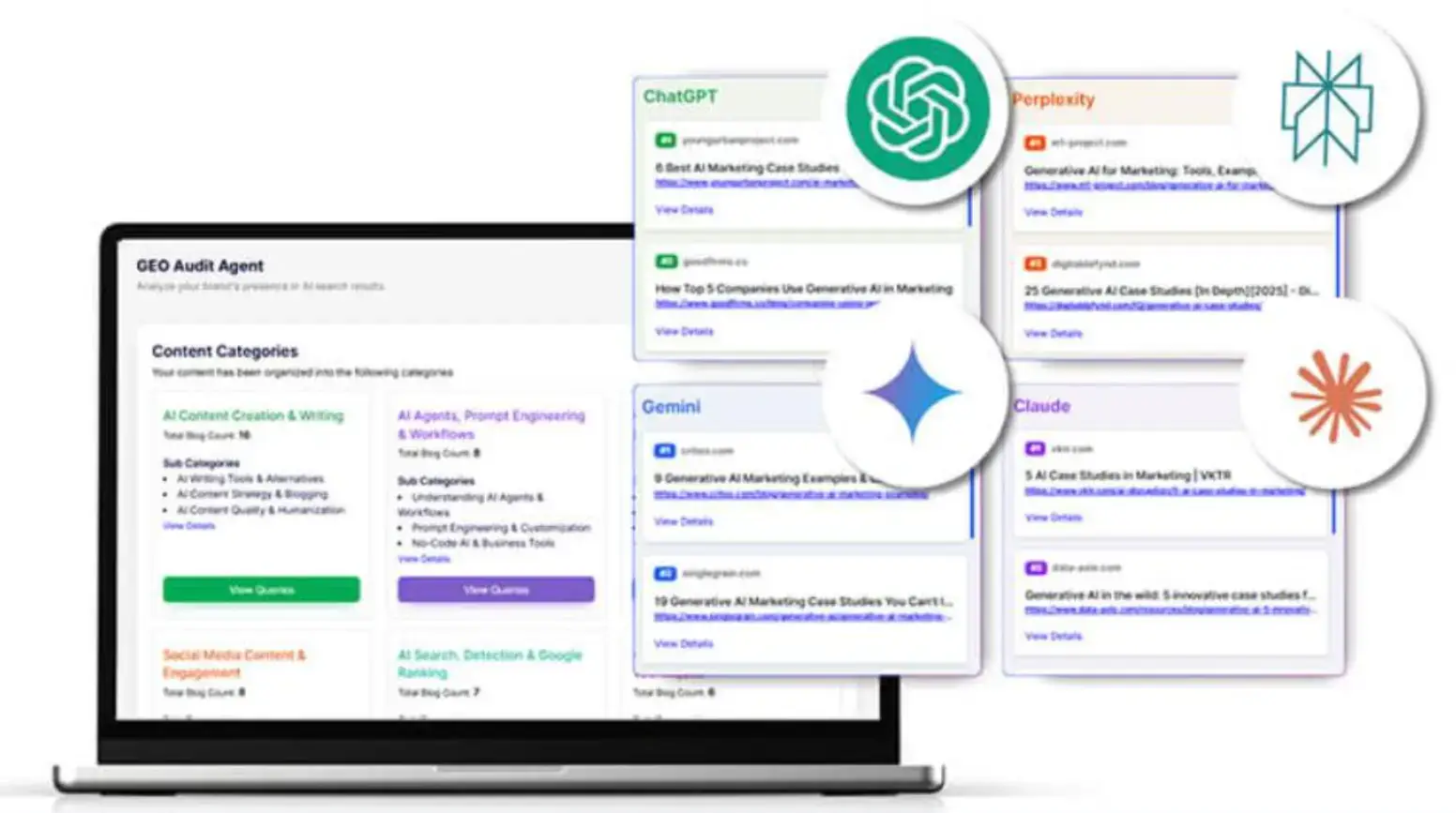
So, yep, SEO becomes as easy as that with the best AI agent tools at hand. Not to mention its potential for GEO (generative engine optimization)! For instance, take Addlly AI’s GEO Agent.
4. Ad Campaign Optimization
If you haven’t yet stepped into the future of advertising with agentic AI, here’s a persuasive argument for doing so from Jeffrey Zhou, CEO and Founder of Fig Loans. He zooms in on the matter from the perspective of finance allocation and return on advertising spend (ROAS):
This is particularly true about Mesha’s AI Agents.
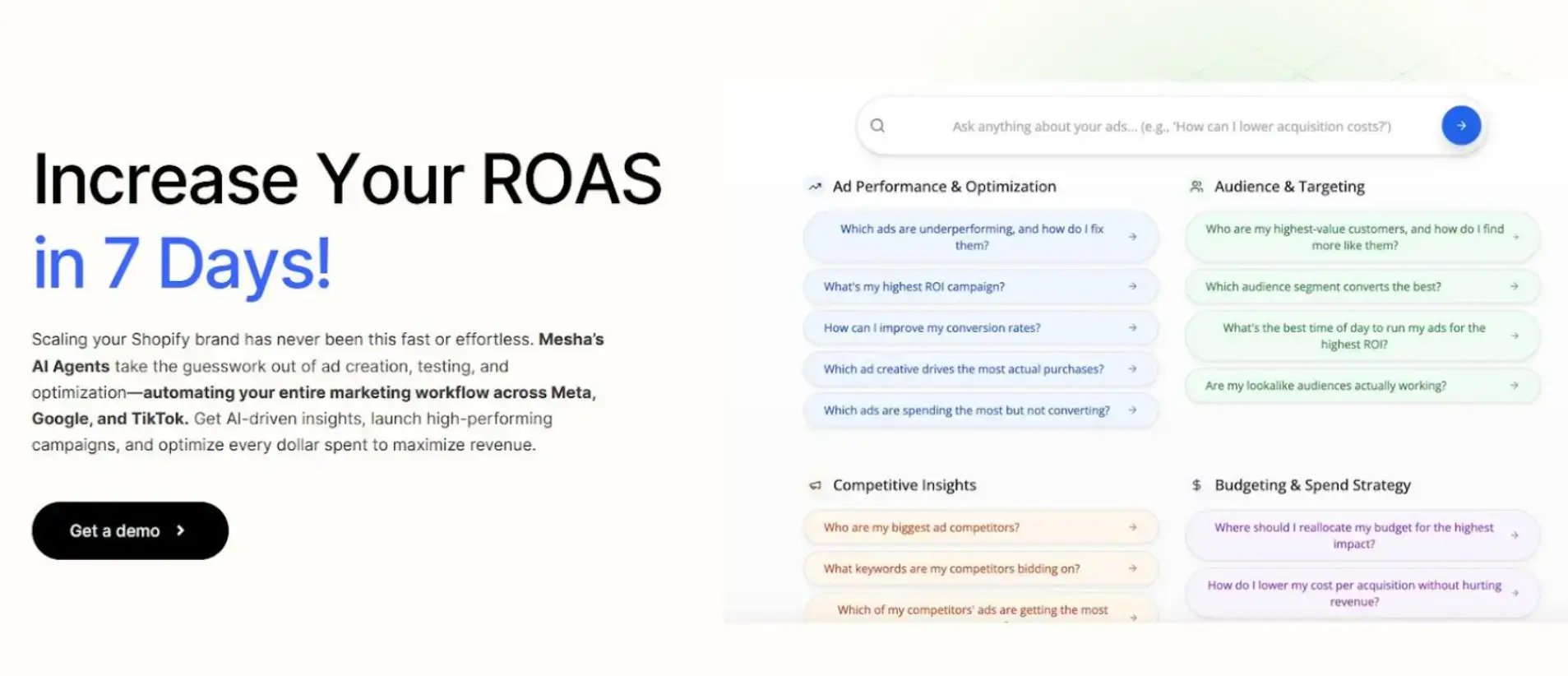
And this is all thanks to AI’s capability to do the following:
- Segment your target audience.
- Distribute adequate budgets for different advertising campaigns (search ads, banner ads, email ads, social media ads, etc.).
- Adjust your ad bids.
- Personalize ads.
- Monitor your ad performance, experiment, and re-optimize ad campaigns in real-time mode as needed.
For example:
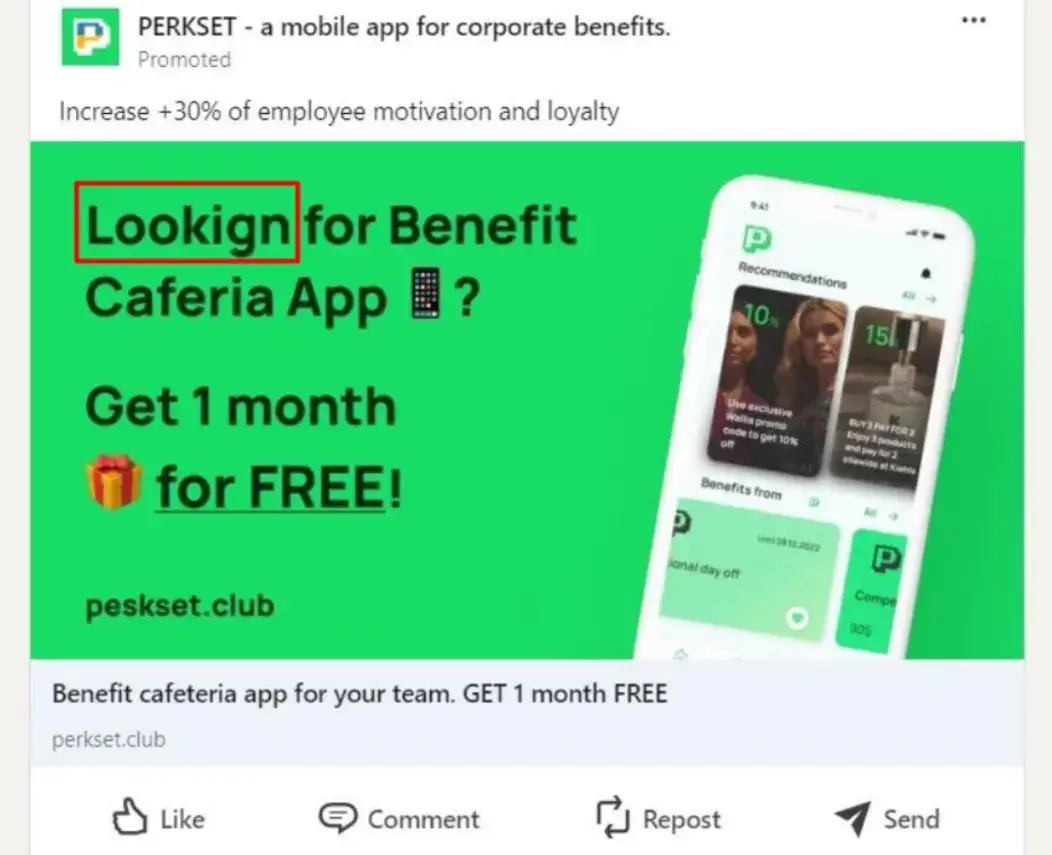
Here’s a LinkedIn ad example that artificial intelligence would have definitely noticed and reported on.
5. Competitor & Trend Monitoring
Competitor Analytics
Your AI agent can act as a spy (but the ethical one) and eavesdrop on your competitors. Integrate it with your social listening tool (Keyhole, Brandwatch, Rival IQ—pick yours) and get every SMM move in full view.
For example:
“[Competitor’s Name] has just launched another social media giveaway.” That’s an alert you might receive from your AI companion.
Or—
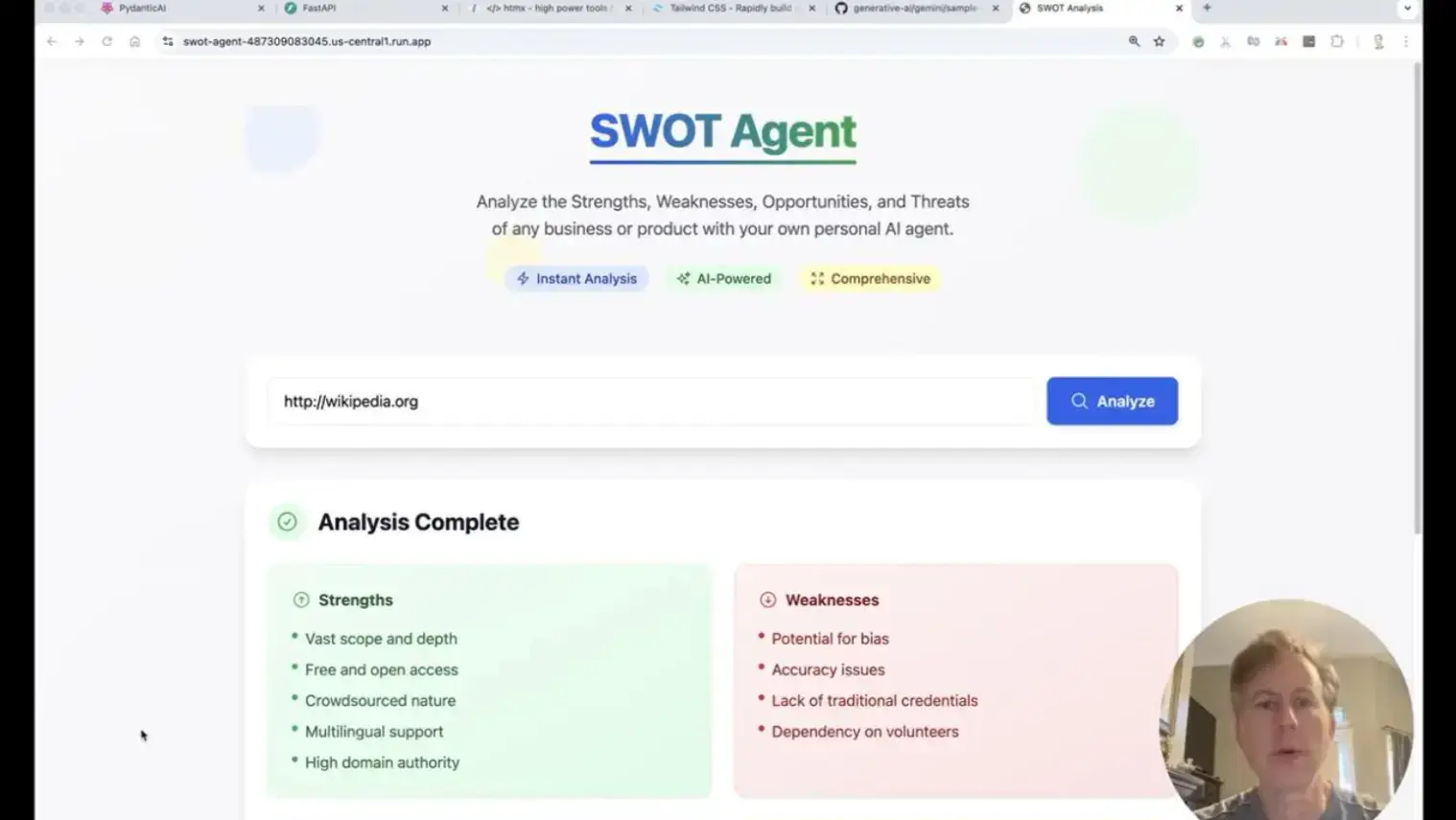
Need a competitive business analysis with SWOT (Strengths, Weaknesses, Opportunities, and Threats)? There you have it!
Trend / News Tracking for Trendjacking
Then, agentic AI can also help you stay tuned to news and trends and hop on them, aka trendjacking or newsjacking.
For example:
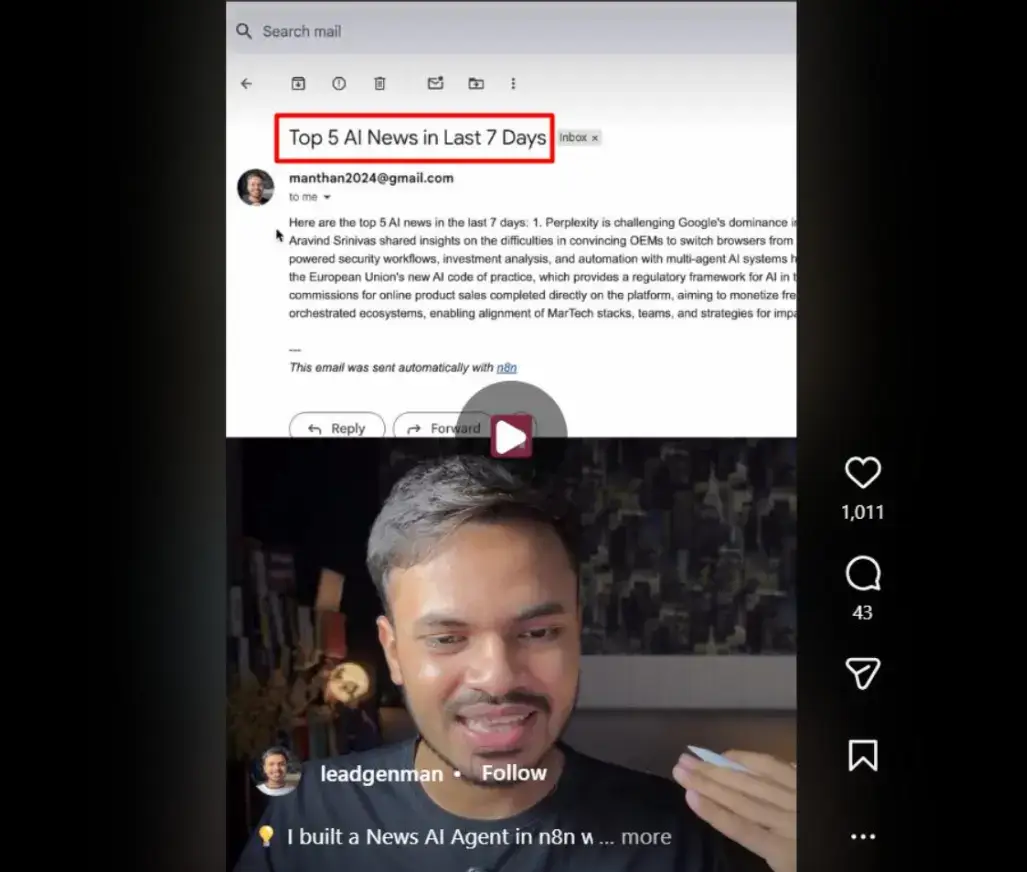
Picture this. A custom News AI Agent captures the latest industry headlines and drops them into your Gmail inbox automatically. But actually, you don’t have to imagine. It’s a reality!
Anna Zhang, Head of Marketing at U7BUY, believes it is essential for fast-moving industries like gaming, where new game releases and technological advancements occur almost daily. She highlights:
For example:
The U7BUY team monitors trending games and proactively writes articles for the gaming blog months before their release to build anticipation among the audience.

6. Event Management
Messy events?
Not on AI agents’ watch.
They can autonomously manage practically any marketing event on your company’s list:
- Product launches/demos
- Webinars
- Conferences
- Workshops
- Podcasts
- VIP customer meetings
- Livestreams
- Or others.
And here’s how they help brands tame the event marketing chaos:
- Plan your events from start to finish
- Send session-specific emails and collect RSVPs
- Segment guest lists
- Create a ticketing structure with early-bird prices or discount coupons
- Follow up with guests
- Visualize event conversions in reports
For example:
The best AI agent tools, such as Envelope for event planning and management, can easily handle such tasks.
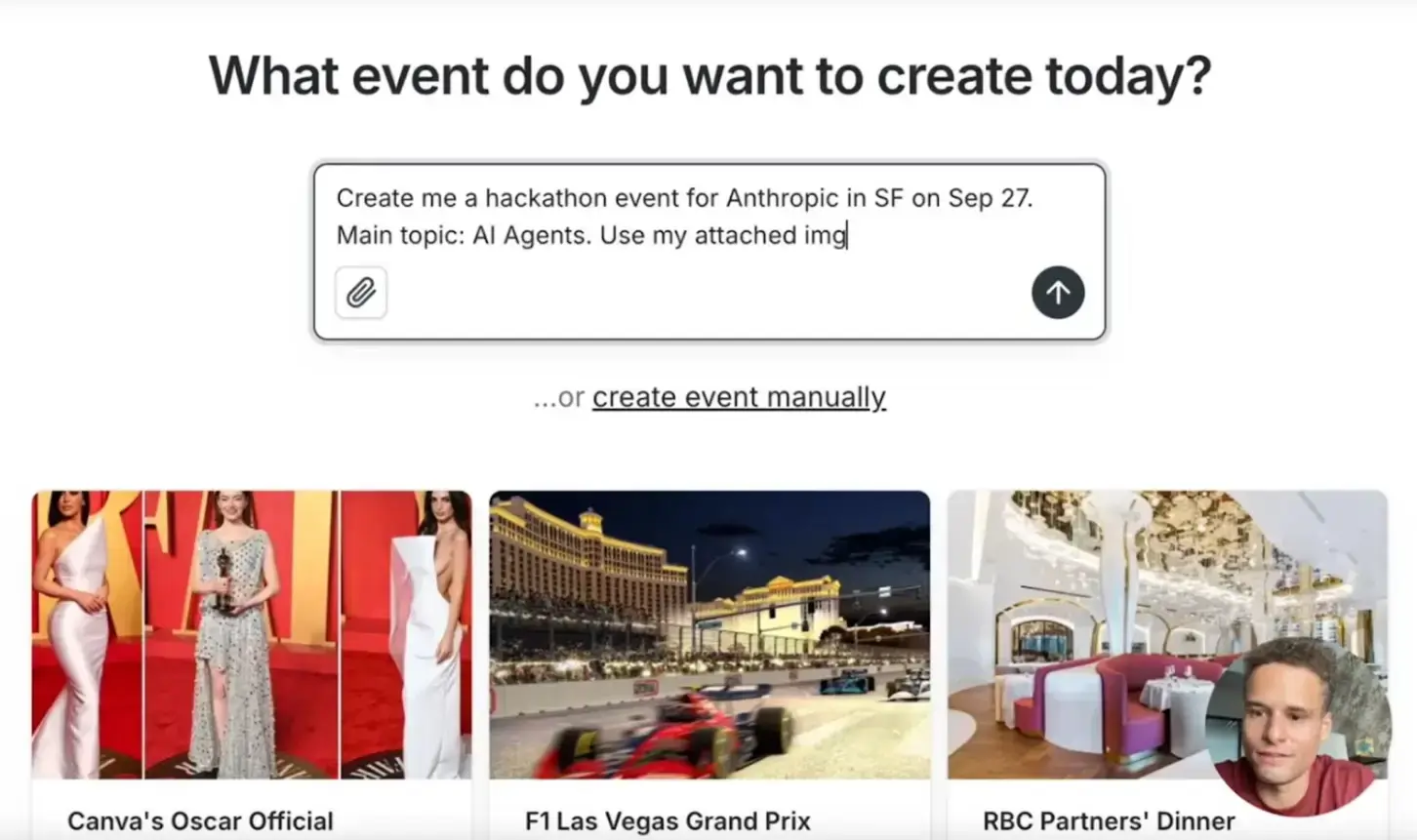
Source: Envelope
7. Team Collaboration & Workflow Cohesion
Finally, let all the marketers on your team welcome a newcomer—a new colleague who will always be there to help your crew collaborate and bond.
Pick agentic AI platforms for collaboration, such as Nimble Buddy (ideal for agile teams) or FuseBase’s AI (fully customizable).
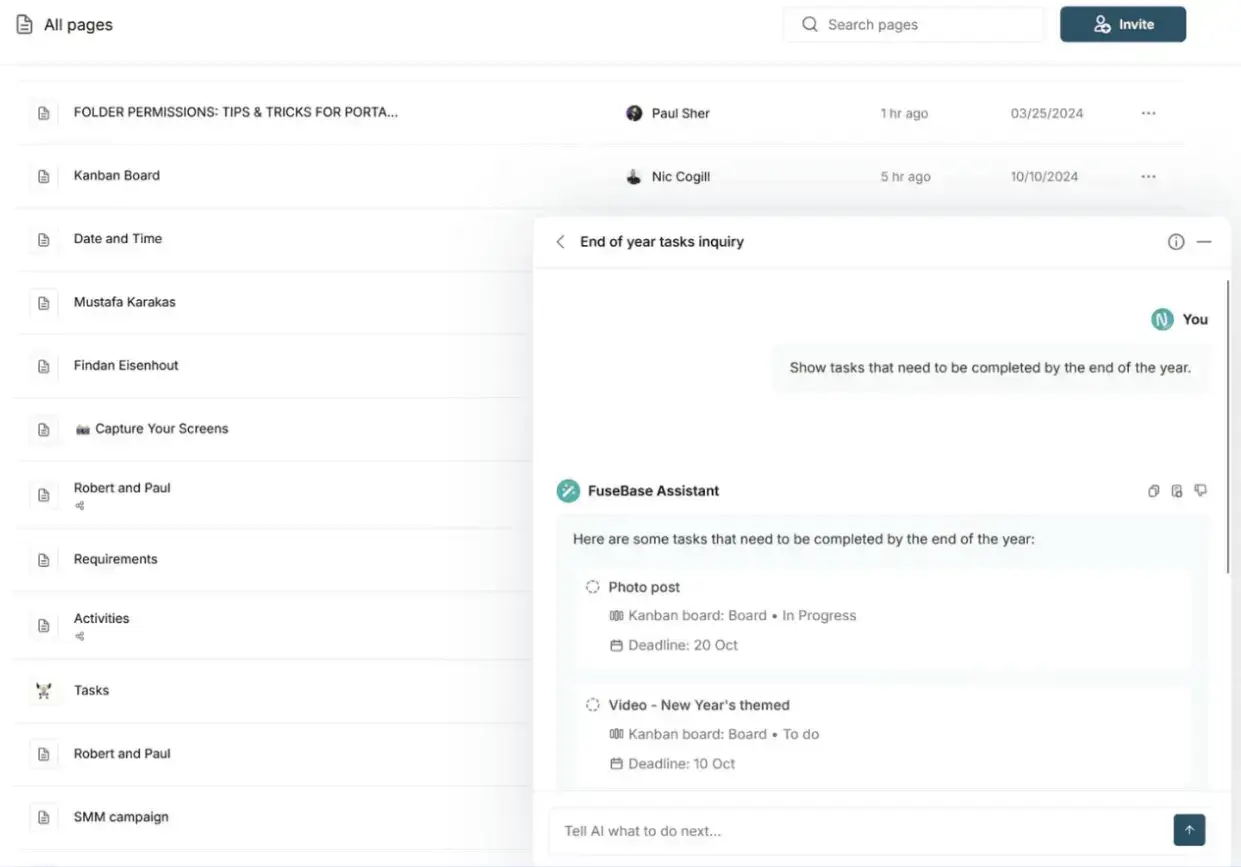
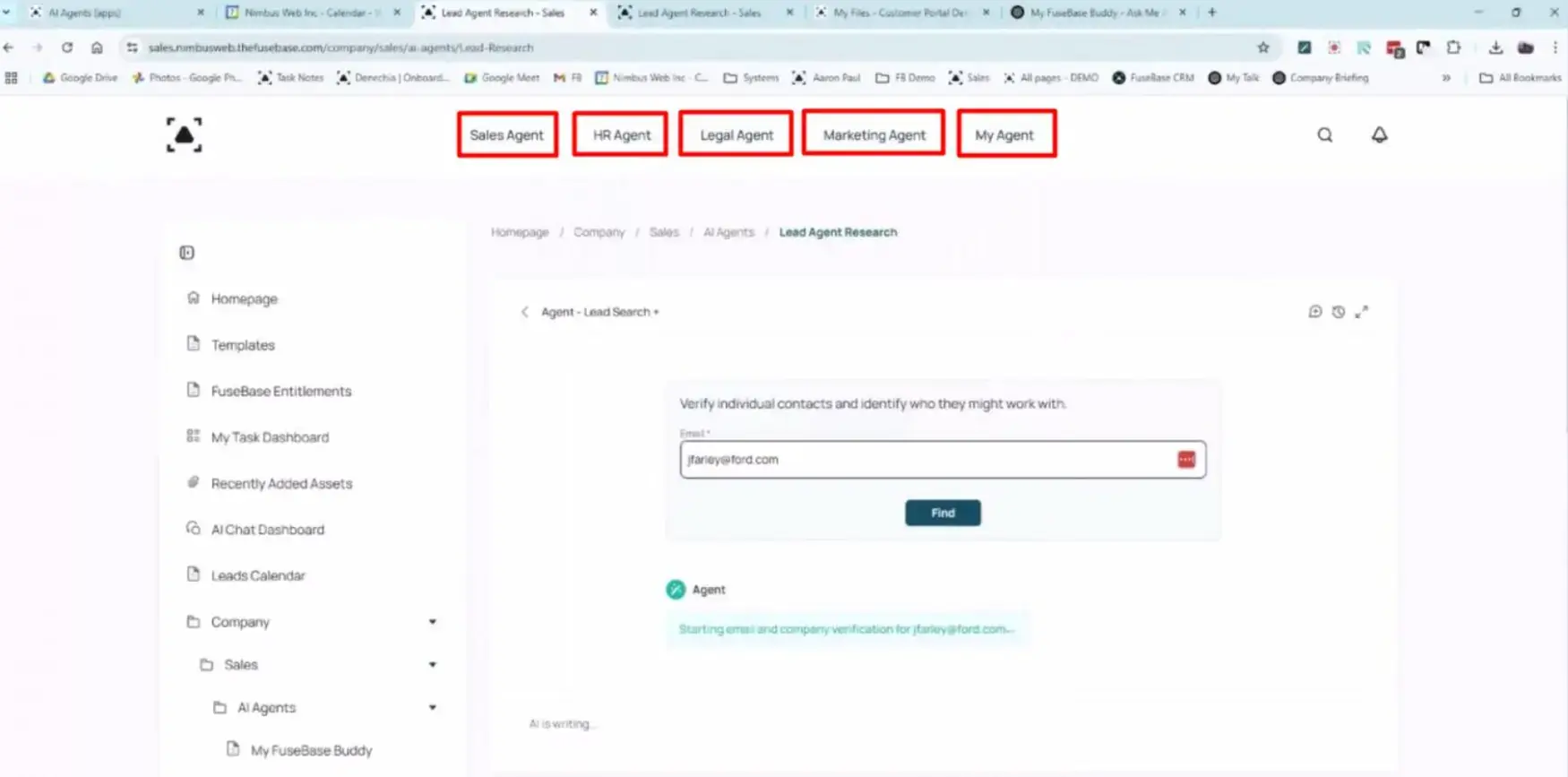
The cherry on top? You can deploy several AI agents for every department and connect them via FuseBase—HR Agent, Customer Support Agent, Marketing Agent, Sales Agent—you name it.
Also, remember the workplace philosophy: Work smart, play hard.
Agentic AI can also facilitate team bonding beyond working hours.
For example:
It can help you pick the right team-building activities for summer or remind you to order (or actually order!) warm corporate hoodies for winter.
An intelligent AI agent can accomplish this task days or even months in advance—before chilly weather hits your colleagues hard in the face so that they get frozen to the bone amid another team outing (say, skiing or ice sculpting) in your marketing dep.
Forget frustrated questions like, “Did we order branded swag for our Christmas party?”—your AI co-worker already did!
Bonus: AI Agent Builders for Custom Marketing Tasks
Feeling inspired to start?
Grab one of the top agentic AI tools for businesses for building your own marketing AI agents based on your unique needs:
- Relevance AI
- Agentforce Builder by Salesforce
- Vertex AI Agent Builder
- Make.com
- n8n AI Agent Builder
- Mindstudio.ai
- Cogniagent.ai
You can either build an omnipotent AI agent or narrow it down to only one marketing task.
For example:
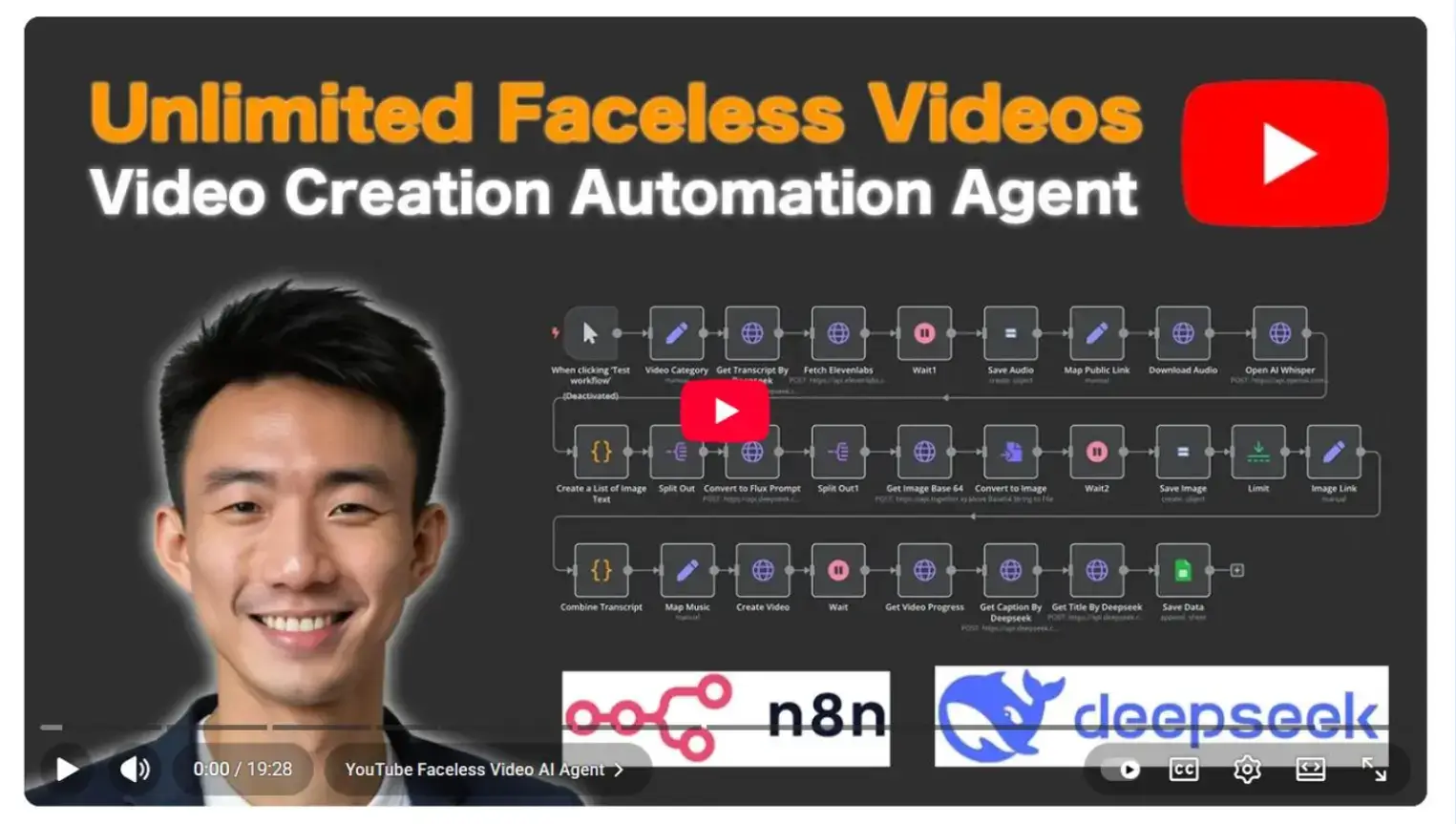
Andy Lo developed an AI-powered YouTube agent for video marketing on the platform. It is a fully automated workflow for generating and publishing faceless YouTube videos. For that, he used several systems, including n8n, DeepseekAI, ElevenLabs, Flux, OpenAI, and others.
Final Thoughts: Entering the Era of Agentic AI
So, marketers are slowly transitioning from AI tools to smarter AI agents.
And as you’re considering this strategic move, too, to improve your marketing workflows with AI, don’t forget about your website waiting for an engagement boost and maybe some renovation.
Explore POWR’s Plugin Library of interactive pop-ups, photo/video galleries, sliders, timers—anything that goes well in line with your AI-driven marketing strategies.
FAQs
1. What Are AI Agents in Marketing?
For marketers, AI agents are independent digital helpers ready to assist with any marketing task. They plan, run, and optimize/improve marketing campaigns, and report on the competition in real time—everything is done autonomously.
2. How Are AI Agents Different From Virtual Assistants & Chatbots?
Unlike chatbots or other language learning models, they are more powerful and autonomous. They typically don’t require prompts. AI agents make decisions all by themselves, learn from flops and errors, adjust on the fly, and/or even coordinate other AI systems.
3. What Are the Most Common Use Cases?
Marketers and brands are using AI agents for different marketing tasks. The major ones, where agentic AI is the most useful, are as follows:
- To generate and manage content
- To personalize customers’ journeys
- To optimize ad campaigns
- To monitor competitors and trends/news
- To manage events
- To collaborate with team members
4. Can AI Agents Replace Marketers?
No. They are more like colleagues rather than competitive candidates for the marketer’s job. They augment marketers’ capabilities and leave room for creativity by accomplishing more repetitive tasks.
5. Do I Need Technical Skills to Build an AI Agent?
Not obligatory. The majority of AI agent builders are no-code platforms (or low-code, at most). So, even if you don’t have any tech competencies, you can build and customize your marketing AI agents via drag-and-drop interfaces and step-by-step instructions.

Author Bio
Brooke Webber is a passionate freelance writer who turned her love for writing into a thriving career. Starting as a content writer, she has honed her skills through continuous learning and diverse experiences. With a relentless pursuit of excellence, Brooke has built a strong portfolio and established herself as a respected voice in the content writing industry.