


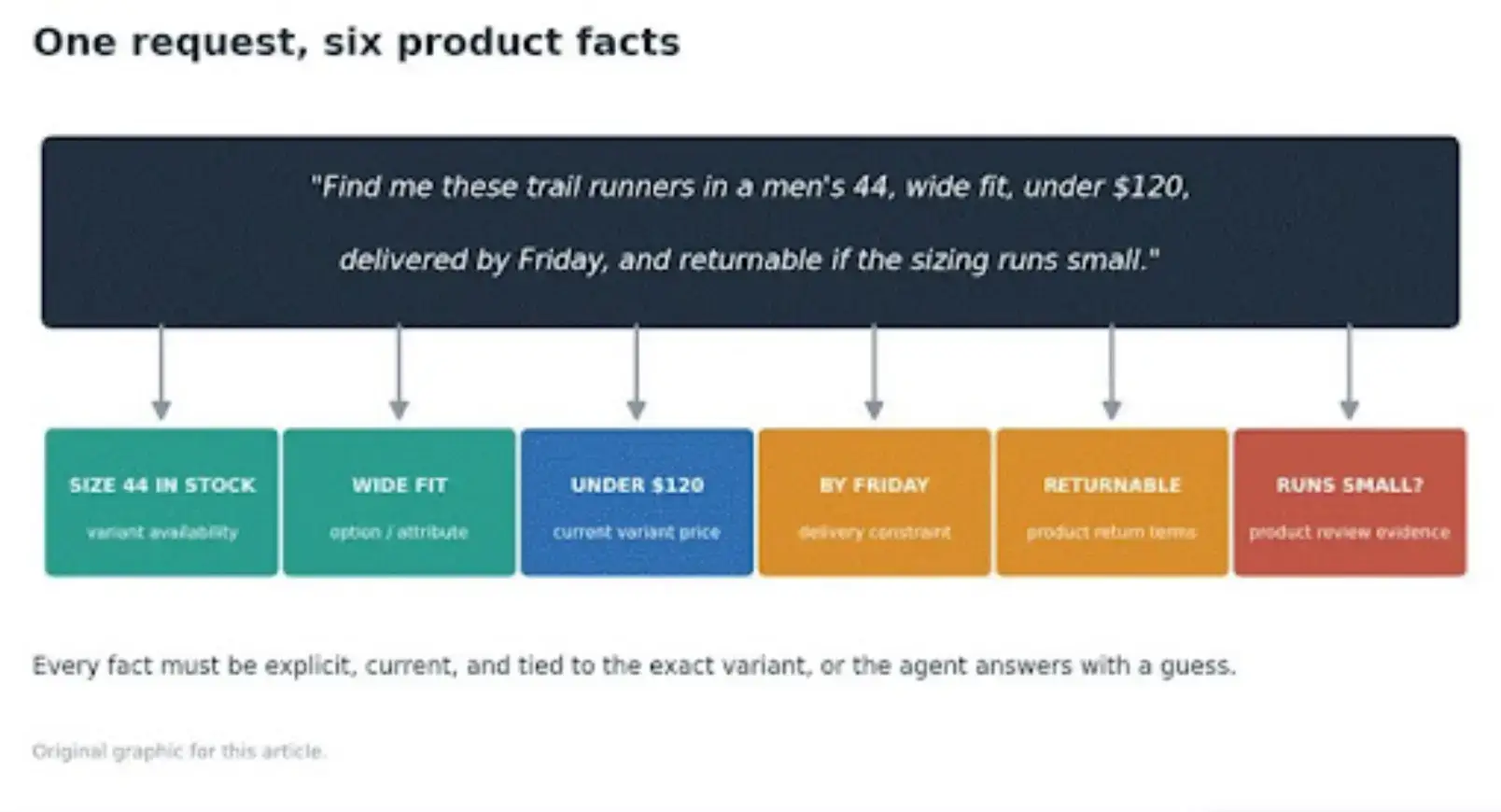
Here's a request that shoppers make every day, and that AI assistants are increasingly making on their behalf: "Find me these trail runners in a men's 44, wide fit, under $120, delivered by Friday, and returnable if the sizing runs small."
A human shopper answers that by poking around your page for a while, squinting at the size chart, opening the returns page in another tab, and giving up roughly a third of the way through.
An AI shopping agent tries to answer it from the facts your store actually exposes, and that's where things get interesting, because most product pages weren't built to answer questions. They were built to persuade.
This matters more than it did a year ago. With the Universal Commerce Protocol, co-developed by Shopify and Google, Shopify merchants can sell directly inside AI Mode in Google Search and the Gemini app, and Shopify's Catalog now feeds agentic surfaces across ChatGPT, Copilot, and whatever launches next quarter.
The pipes exist. The open question is whether your product data can flow through them without turning into guesswork.
So, before rewriting a single line of sales copy, it's worth running your page through the five questions an agent must answer. That audit is what this article is for.
What Agents Actually Read From Your Page
It needs stable, structured, current facts that describe the same purchasable item everywhere those facts appear. Not better adjectives.
The same price on the visible page, in the structured data, and in any feed; options that map to real variants; policies that can be tied to the product rather than buried in a footer PDF.
Shopify's own documentation for agentic storefronts is clear about where those facts come from: titles, descriptions, options, images, price, and availability are drawn from your product and catalog fields, and agents may also inspect the site itself. In other words, the agent reads what your catalog says, not what you meant.
Every product includes yours, and scaling to it requires your data to hold up. The responsibility runs in one direction, too.
Shopify's Catalog structures and distributes whatever your product fields contain, but it can't invent facts you never entered, so a store with vague options and prose-only sizing stays exactly as ambiguous on every new surface it reaches.
Persuasive copy still matters, and nothing here suggests replacing it. But copy and decision data do different jobs, and the audit below tests only the second one.
Five questions: can the agent identify the exact product and variant, price it, ship it, return it, and trust it? Our guide to preparing product content for AI search covers the wider discovery context; here we stay on the page itself.
Can the Agent Identify the Exact Product and Variant?
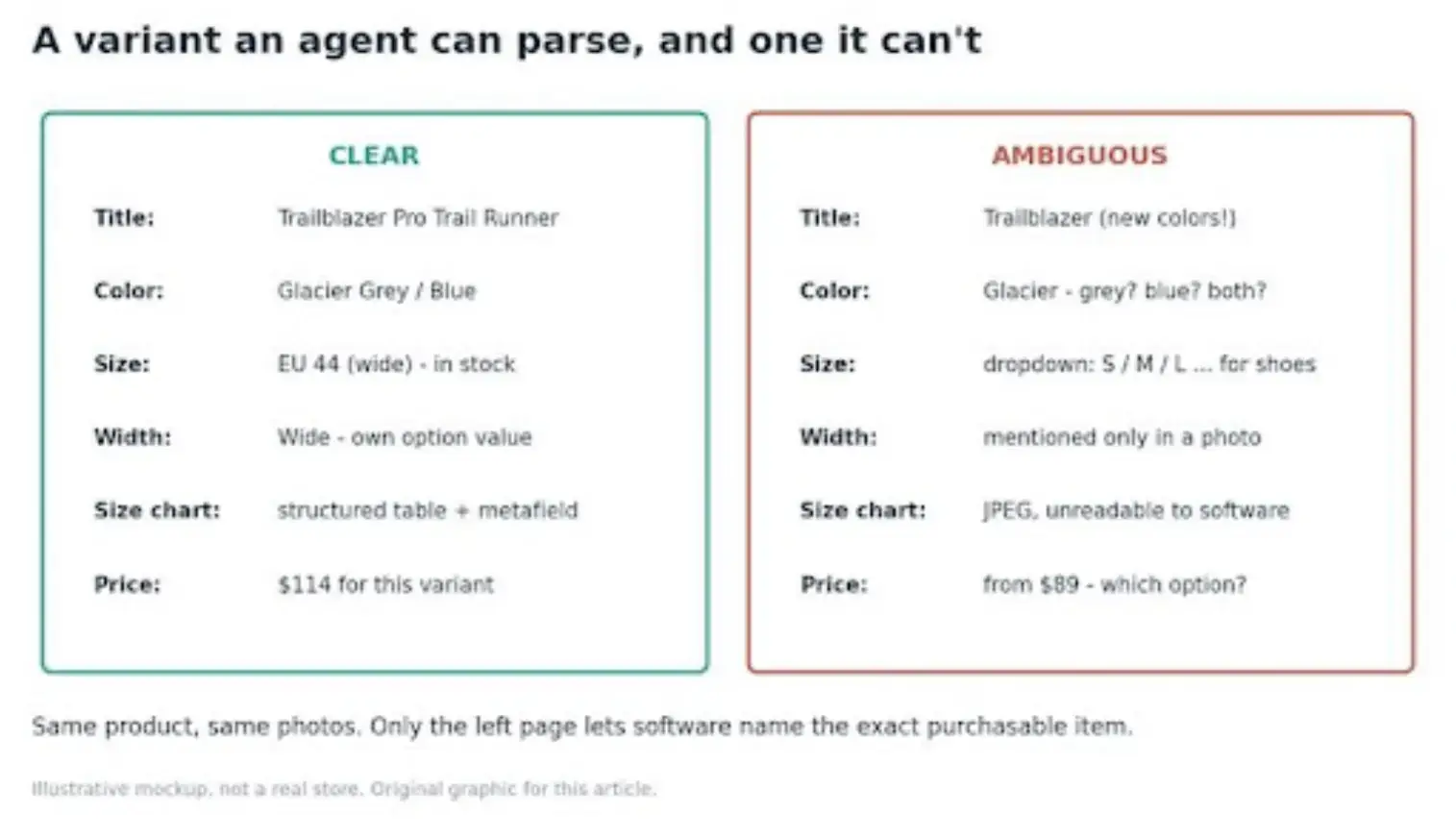
Only if your title, options, and variant values point to one unambiguous purchasable item, and on many stores they don't. This is the failure I see most, and it's rarely a writing problem.
The classic pattern: the title says "Trailblazer Pro," the color option says "Glacier," the size chart is a JPEG, and the fact that "Glacier" means light grey with blue laces exists nowhere except the third photo.
A human shopper resolves this in a few seconds of looking. Software resolving it has to guess, and an agent that guesses about which variant is which has already failed the shopper, however lovely your photography is.
The repair order matters here. Fix the native Shopify fields first: real option names and values, one variant per purchasable combination, identifiers where they exist, and dimensions or compatibility in structured attributes and metafields rather than only in prose. Then let the page copy explain what the fields declare.
Consistent product attributes and tags make those fixes easier to maintain once the catalog grows past the point where you remember every SKU personally.
Do Price and Availability Agree Everywhere?
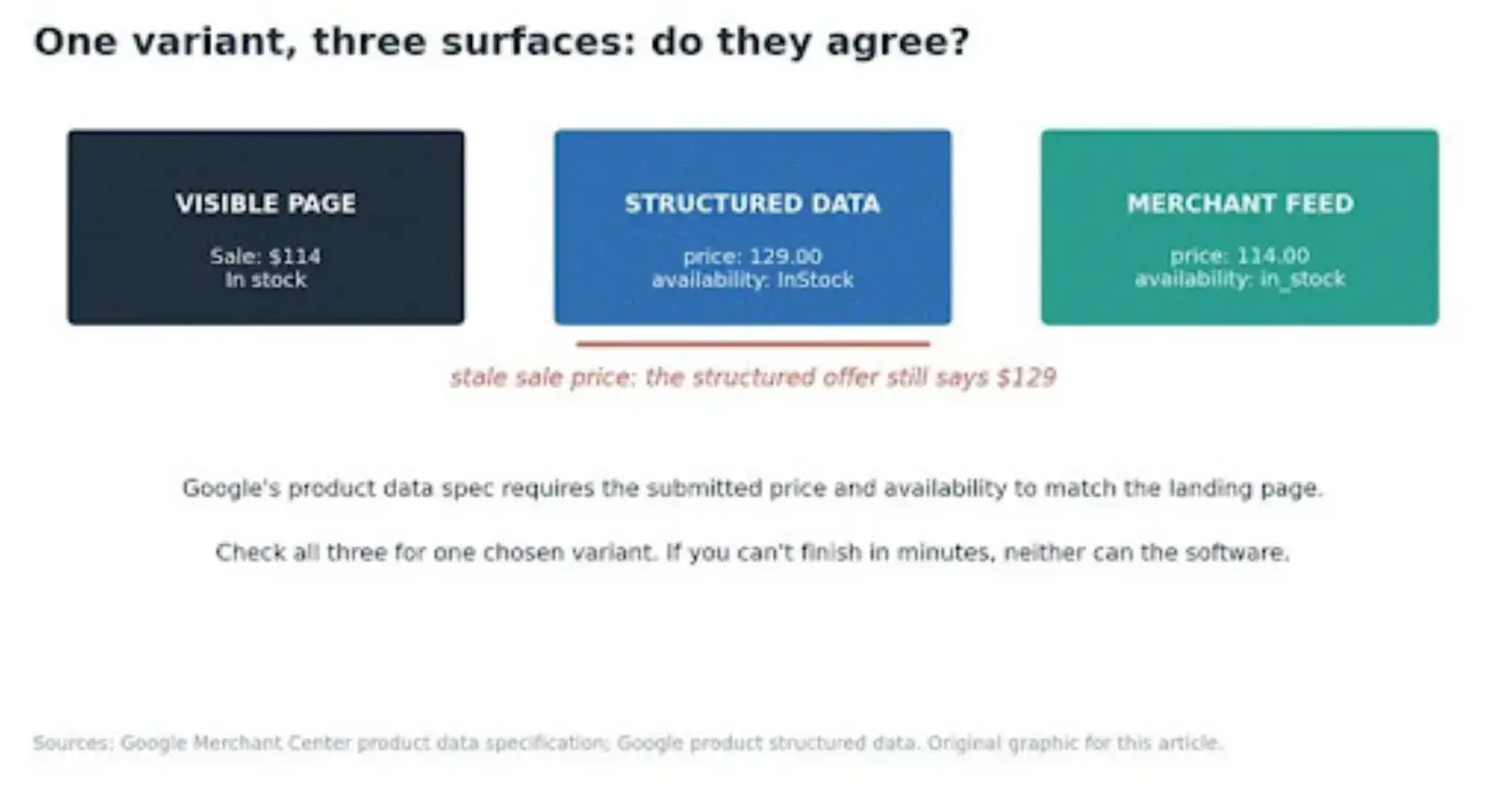
An agent needs the selected variant's current price and stock state to match across the visible page, the structured data, and any feed, and "the right number is somewhere on the page" doesn't clear that bar.
The sneaky failures aren't typos. A "from $89" price where the agent can't tell which option costs $89. A sale price in the visible copy while the structured data still carries last month's number. A default variant that's out of stock while the page cheerfully says "in stock" about its siblings.
Each surface is defensible on its own; together they make the page unanswerable, and an agent comparing you against a competitor with boring, consistent data will prefer the boring competitor. It's worth being blunt about the schema angle here.
Markup is one surface out of several, and it helps only while it agrees with the visible page and the feed; structured data carrying a stale price is arguably worse than none, because it states the wrong fact with confidence.
The test is mechanical. Pick one variant, then read its price and availability in all three places yourself. If you can't finish that check in a few minutes, the agent's odds aren't good either.
Can It Work Out Shipping and Returns Before Checkout?
Not reliably, on most stores, because delivery limits and return terms usually live in generic policy pages that no software can tie back to the product in the cart. And here it's worth separating two different results: a wrong answer, and no answer at all.
A page that leaves the agent unable to say whether the shoes arrive by Friday hasn't lied to anyone. It has simply dropped out of a purchase decision where delivery was half the question.
The commerce platforms are pushing this information toward explicitness. Google's 2026 Merchant Center updates added more granular shipping attributes, and its return policy guidance now supports product-level return windows and costs, because "see our returns page" was never going to survive an ecosystem where software compares offers. Treat that as the direction of travel: your policies are becoming product data, whether they're formatted that way yet or not.
The practical fix is modest. State the product-specific facts where the product lives: oversized-item surcharges, restricted destinations, the return window, and who pays return shipping. Keep the lawyerly version on the policy page by all means; just stop making it the only copy.
Are the Trust Signals Specific Enough to Use?
Trust evidence helps an agent only when it can be tied to this product and doesn't contradict the catalog facts, which is where a lot of hard-won social proof quietly does nothing.
A wall of homepage testimonials about your lovely customer service isn't attached to anything an agent can use when the question is whether the size 44 runs narrow.
Product-level reviews are different, because they answer the shopper's actual uncertainty: fit, durability, whether the color matches the photos.
Review count, rating, and recency belong with the product, structured so they can be read alongside price and availability rather than floating in a widget the crawler treats as decoration.
Be careful with the claim, though. Nobody outside the platform companies knows exactly how any given agent weighs reviews, and this article won't pretend otherwise.
What's verifiable is that specific, product-attached evidence is usable, and generic praise mostly isn't. A Shopify product-review workflow can put that evidence beside the product decision instead of three clicks away from it.
Score Your Page: The Five-Question Audit
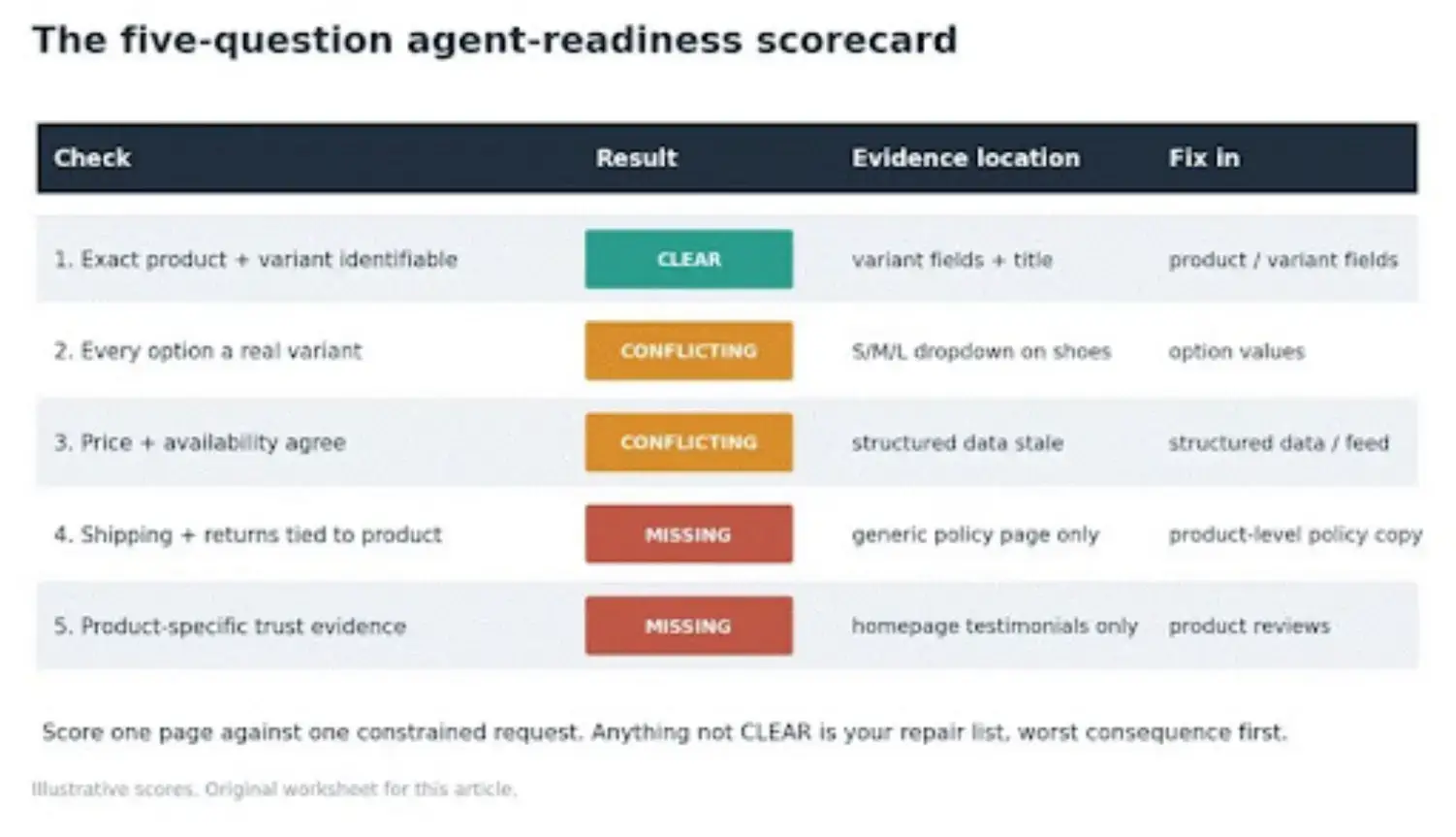
Give one product page a single constrained request, like the trail-runner request that opened this article, and score each fact as clear, conflicting, or missing.
Nothing fancier than that:
- Identity. Can the exact product and variant be named from fields, not photos? Note where the answer lives.
- Options. Does every purchasable combination exist as a real variant with real values?
- Price and availability. Do the visible page, structured data, and feed agree for the chosen variant?
- Shipping and returns. Can delivery constraints and return terms be tied to this product and destination?
- Trust. Is there product-specific review evidence, and does it contradict anything the catalog claims?
Score honestly, write down the evidence location for each answer, and you have a repair list ranked by embarrassment.
A page that scores five "clear" answers is rare, and I'd argue that a merchant who runs this test quarterly will beat a merchant with better copy and worse data in most agent-mediated comparisons that matter.
Fix the Catalog Before You Rewrite the Sales Copy
The repair order runs opposite to instinct. Instinct says polish the copy, because the copy is what you can see.
Start instead with the product and variant data that controls identity, options, price, and availability, since everything downstream inherits its mistakes.
Then move dimensions, compatibility, and materials into structured attributes and metafields. Make shipping and return terms explicit at the product level.
Only then rewrite the human-facing story, and add product-specific review evidence where the shopper's real doubts live.
Shopify's Catalog will carry that data to agentic surfaces once it exists; platforms like Commerce, whose Feedonomics arm describes syndicating enriched catalogs to agentic discovery surfaces, show the same pattern from the enrichment side. But no pipeline repairs facts you never recorded.
Your product page still has to charm a human. It just shouldn't make software guess what you're selling, because increasingly, the software is the one asking.
If the trust question is where your audit failed, add product-specific review evidence with POWR Product Reviews and let your customers answer the fit question for you.
